
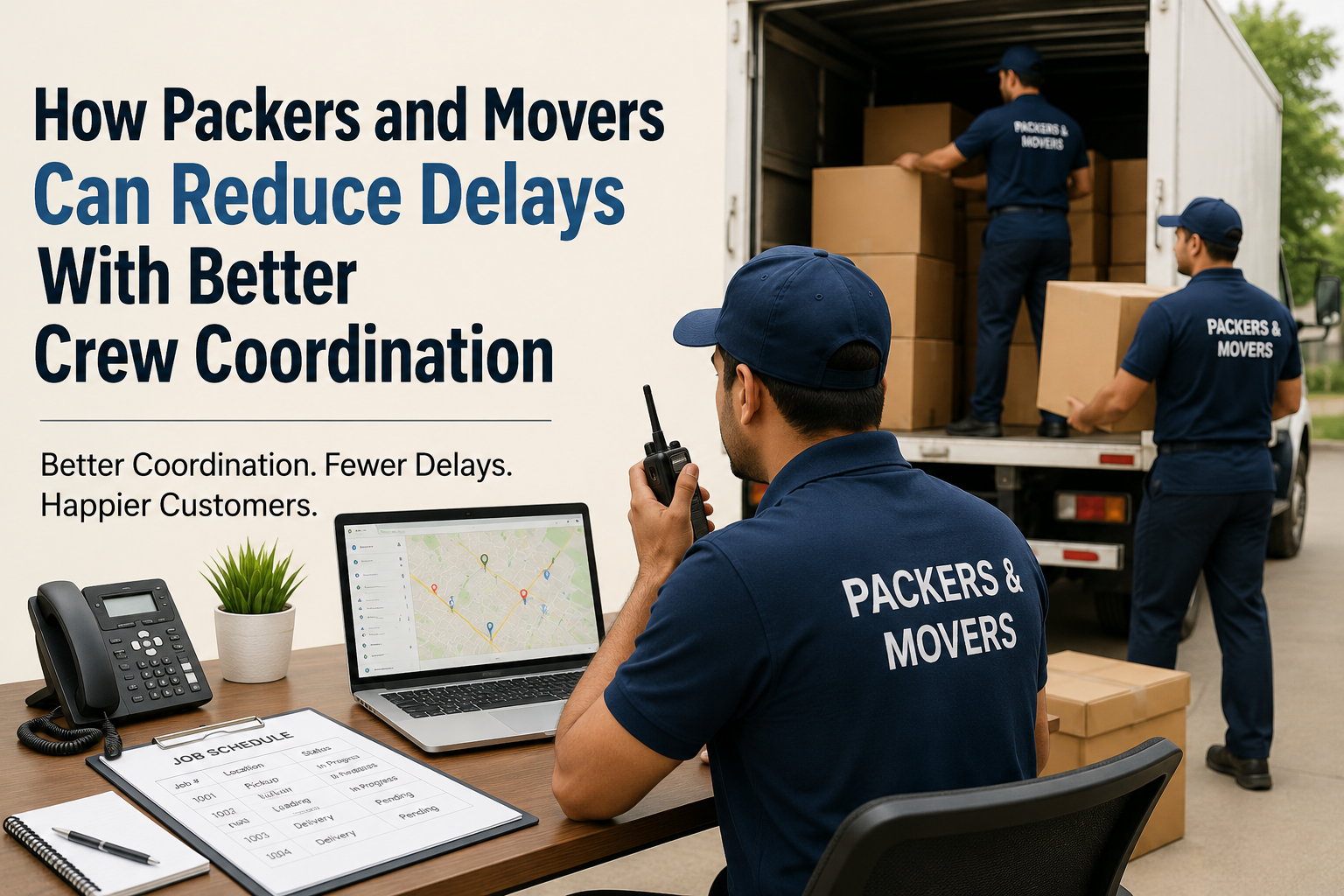
If you own a packers and movers company in India, then you must be aware of the experience. You have the truck fully loaded, the customer is waiting at his new location, and some way or the other, half of your team is still at the old location due to the simple reason that they were not informed that the loading process was delayed. This is not mere bad luck. This is the consequence of crew management of packers and movers by relying on calls and WhatsApp messages and the power of memory alone.
Delays rarely happen because your team is lazy or careless. They happen because information does not travel fast enough between the office, the driver, the loaders, and the customer. By the time someone realizes there is a problem, the truck is already an hour behind schedule.
Why Moving Jobs Get Delayed in the First Place
Before fixing the problem, it helps to understand where things actually go wrong. Most operational delays in this industry come from a handful of repeat offenders.
No clear job briefing. Crews often show up to a site without knowing the full scope of the job, whether there is a lift available, how many floors they are dealing with, or whether the customer has any special items like a piano or an aquarium. This leads to on-site confusion and lost time.
Overlapping schedules. When job assignments are managed on a whiteboard or a group chat, it is easy to double-book a crew or a vehicle without anyone noticing until the morning of the move.
Poor visibility for the office team. The person coordinating from the back office often has no real way to know where a crew is at any given moment. They are relying on someone picking up a phone call, and calls get missed during a heavy loading job.
Last-minute crew changes. Someone falls sick, a vehicle breaks down, or a job runs longer than planned, and now the next job in line is short-staffed with no backup plan ready.
Each of these on its own seems small. Together, they are exactly why packers and movers operational delays keep piling up week after week, quietly eating into both revenue and reputation.
What Good Crew Coordination Actually Looks Like
A well-run moving company does not avoid delays because it never runs into problems. It avoids delays because problems get spotted and solved before the customer even notices. That difference comes down to how well the crew, the office, and the vehicles are connected.
Coordination requires that each individual knows their responsibilities in advance and not while proceeding to the work location. It requires that the office knows where each crew is at any point in time, whether free, working, or late. This also requires that whenever there is a change in plans, all those affected will be informed immediately.
This is where crew management for moving companies stops being a nice-to-have and becomes something that directly protects your bottom line. When you can see your entire day’s operations at once instead of piecing it together from five different phone calls, you start catching problems while they are still small.
Real-Time Tracking Changes the Game
One of the biggest shifts happening in the Indian moving industry right now is the move toward real-time crew tracking that moving business owners can actually rely on. Instead of calling a supervisor to ask, “Where is the team right now,” the answer is visible on a screen.
It is more important than one would think. Instead of making a guess as to when the truck will be there, your people have a definitive response they can provide that is both true and reliable. If the job has been delayed in any way, the office will know right away and can either schedule accordingly or send reinforcements. There is little that can build a customer’s confidence more than transparency.
Scheduling Is Half the Battle
The vast majority of the delays originate from lack of proper planning and not bad execution. Scheduling the correct crew for packers and movers implies using the appropriate amount of staff, their skill set, and the appropriate vehicle for the task without any overlap or understaffing.
It is possible to use spreadsheets, or even paper registers, for manual scheduling when the daily load does not exceed two or three jobs. However, when the operations scale increases, manual scheduling fails, particularly at the height of the relocation period when all the crews get overloaded. With properly managed crew scheduling, it is ensured that no one is overloaded and that there are realistic allowances for traffic and loading times.
Why Technology Is Becoming Non-Negotiable
More moving companies across India are now turning to crew management software to bring order to their daily operations. This is not about replacing your team’s hard work; it is about giving them the information they need at the right moment.
An effective system allows you to assign the work digitally, monitor the process as the crews complete each job, and be alerted at the first sign of any delays. Combine that with mobile job tracking software, and you will have real-time data on all trucks, crews, and jobs without making even one phone call.
It is precisely this kind of disconnect that a good packers and movers CRM solution in India addresses. Rather than having one book for handling customer inquiries, another for handling task assignments, and yet another for billing, everything comes together in one place. The sales team is aware of the commitment made to the customer, while the operations team has an understanding of what is to be delivered, and the crew is aware of the exact location at which it is to operate. Such an interconnected approach, similar to that adopted by companies like MoveMitra through its dedicated crew management solutions, streamlines the process immensely.
Practical Steps You Can Take This Week
You do not need to overhaul your entire business overnight to see improvement. Start small:
- Brief every crew on job specifics before they leave the office, not after they arrive.
- Keep a single, shared view of the day’s schedule instead of splitting it across notebooks and chats.
- Set a simple check-in routine so the office knows the status of every active job.
- Build a small buffer into every schedule for travel and loading delays.
- Have a backup plan for at least one crew member per shift in case of last-minute absence.
None of these require a big budget. They require discipline and, eventually, the right tools to make that discipline easy to maintain as your business grows.
The Bottom Line
A delay does not have anything to do with effort; delays happen when information does not get to the right person on time. Each time there is better coordination, through better briefings, better scheduling, or live tracking dashboards, the little bits of time that get wasted get shaved off. For moving companies operating throughout India that would like to grow without losing control over their operations, better coordination might be one of the easiest ways to safeguard margins and reputation.
Frequently Asked Questions
Q1. Why do packers and movers face frequent delays on job days?
Common causes include unclear job details, overlapping schedules, and poor visibility into job progress.
Q2. How can crew coordination reduce delays?
Clear assignments and real-time progress tracking help teams spot problems early and avoid customer delays.
Q3. What is the best way to manage crew scheduling?
Use a centralized scheduling system to manage jobs, vehicles, and crew availability without double-booking.
Q4. Can real-time tracking prevent moving job delays?
Yes. It helps the office monitor crews and make quick changes before delays affect the next booking.
Q5. Is crew management software worth it for small moving businesses?
Yes. It can reduce scheduling errors, manual coordination, and problems as job volume increases.
Q6. How does a CRM help packers and movers in India?
A moving CRM connects enquiries, quotes, crew assignments, and billing in one system.
Q7. What should a moving company check before assigning a crew?
Check property access, floors, special items, vehicle needs, and expected job duration.
Q8. How much time can better crew coordination save?
A structured system can save several hours of weekly admin work and help reduce delays and customer complaints.