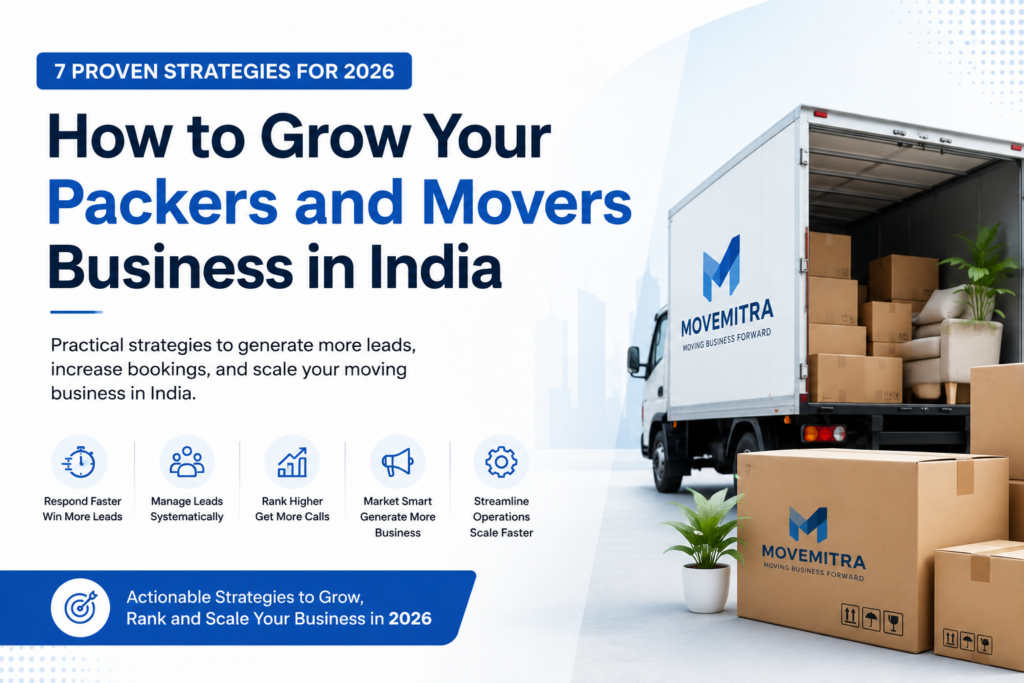
Every packers and movers owner reaches a point where they look at their business and think we’re getting inquiries, we’re completing moves, but somehow we’re not growing the way we should be. Revenue is flat. The same customers don’t come back because people don’t move every year. New leads flow in, but the conversions don’t seem consistent. And out there somewhere, your competitor is working harder while you’re not. Does this sound familiar? If so, this blog will be extremely helpful for you. These are the actual strategies that help grow packers and movers’ business in India in 2026 — not generic business advice dressed up in moving industry language, but specific, practical approaches that address the real challenges of building a successful moving company in the current Indian market. Whether you’ve just started or you’ve been running a packers and movers business in India for years, at least a few of these will show you a gap you haven’t yet closed.
Why Growing a Moving Business in India Is Different in 2026
The Indian relocation market has changed significantly over the last three to four years. Digital platforms have made it easier for customers to compare multiple companies simultaneously, which means the window between when a customer sends an inquiry and when they book with someone has compressed. The customer who once waited a day for quotes is now expecting to hear back in hours, if not minutes.
At the same time, online reviews have become a primary trust signal in a way they weren’t five years ago. A moving company with 200 Google reviews averaging 4.6 stars wins business from searchers before a competitor with 12 reviews even gets a chance to quote. And digital marketing — Google Ads, local SEO, and social media have become the primary acquisition channel for most urban Indian moving companies, replacing the referral-only model that sustained many businesses in the past.
Growing in this environment requires a combination of operational excellence, digital presence, and systematic follow-through that most moving companies haven’t yet built. Here’s how to build it.
Strategy 1: Fix Your Lead Response Time First
This is the single highest-leverage improvement most Indian moving companies can make — and it costs nothing except the willingness to change how quickly you respond.
The data on lead response time in service industries is unambiguous: the probability of converting a lead drops dramatically as response time increases. A customer who sends a moving inquiry and receives a professional quote within 15 minutes is significantly more likely to book than one who receives the same quote three hours later. Why? Because in those three hours, they’ve received quotes from competitors, had time to overthink the decision, and moved on mentally.
Most Indian moving companies respond to inquiries in hours, not minutes — because generating a quote requires manual calculation, finding a template, formatting it, and then sending it through WhatsApp or email. This process takes time, and during busy periods it takes even more.
The fix is systematising your quotation process so it takes minutes rather than hours. It means having a defined pricing structure for common move types, a professional quote template, and ideally a system that helps you generate and send quotes faster than you’re doing now.
Moving business tips that focus on speed of response consistently produce the fastest visible improvement in conversion rates for packers and movers businesses — because most competitors are slow, and being fast is an immediate differentiator.
Strategy 2: Build a Systematic Lead Management Process
Most moving companies manage their leads reactively. An inquiry comes in on WhatsApp. It gets replied to. If the customer responds, the conversation continues. If they don’t, the lead quietly disappears — because there’s no system to follow up, no reminder to check back, no process for re-engaging someone who expressed interest and went quiet.
It’s one of the most significant revenue leaks in the packers and movers business growth story — leads that were genuinely interested but never got a second contact from the company after the initial quote.
Packers and movers lead generation is only half the equation. Converting those leads into bookings is the other half, and conversion requires systematic follow-up that most moving companies are not doing consistently.
A simple follow-up system would be as follows:
The quote will be sent on Day 1. If there is no response by Day 3, send one follow-up email. If there is still no response by Day 6, send one more short follow-up email.
If the customer provided a move date in their first contact email, schedule the follow-up near that date.
This three-touch follow-up system — which takes minutes to execute but requires a reliable reminder system to happen consistently — recovers a meaningful percentage of leads that would otherwise be permanently lost.
CRM Software for packers and movers business is what makes this systematic, rather than dependent on someone remembering to follow up. When every lead has a next-action scheduled in a system that sends reminders, follow-up happens consistently regardless of how busy the business is.
Strategy 3: Invest in Your Google Business Profile and Local SEO
When someone in Bengaluru or Mumbai searches “packers and movers near me” or “packers and movers [city name]”, Google shows a local map pack — three businesses with their reviews, ratings, and contact information prominently displayed before any paid ads or organic website results. Appearing in this map pack is one of the highest-value positions available to an Indian moving company, and most companies are leaving it entirely to chance.
Moving company business strategy for digital presence starts with Google Business Profile because it’s free, directly drives calls and inquiries, and has a disproportionate impact on local search visibility relative to the effort required to optimise it.
A fully optimised Google Business Profile for a moving company should include:
Accurate and complete business information — name, address, phone number, website, hours, and service areas. Your primary category should be “Moving Company” with relevant secondary categories added. A full description that mentions your key services and locations served. Regular posts — once a week is ideal — covering promotions, tips, or service highlights. Before and after photos of completed moves, your vehicles, and your team. A consistent strategy for collecting reviews from satisfied customers.
That last point deserves its own emphasis. For Indian moving companies in 2026, Google review volume and recency are among the most significant factors in local search ranking and customer trust. A company with 150 recent reviews will consistently outperform a technically superior company with 15 reviews — because potential customers read reviews before making the call.
Build collecting reviews into your post-move process. Every completed move is an opportunity. A simple, direct message to the customer with a link to your Google review page — sent the day after their move when they’re settled and relieved — converts at a surprisingly high rate when it’s done consistently.
Strategy 4: Build a Referral Programme That Actually Works
The moving industry is one of the best industries for referrals — but almost no Indian moving companies have a structured programme for generating them. People who have had a positive moving experience actively want to share it. They’re grateful, they feel good about their decision, and they genuinely want their friends and family to have the same smooth experience if they need to move.
The problem is that customers don’t think to refer unless they’re prompted. And the window for prompting is narrow — the day after the move, when the relief and gratitude are highest, is the golden moment for referral requests.
A simple referral programme for a packers and movers business works like this. Every customer who completes a move receives a message the following day thanking them for choosing your company and offering them a defined discount or benefit for every friend or family member they refer who books a move. The benefit should be meaningful enough to be memorable — a 5% discount on the friend’s move and a cash reward for the referrer is a common structure that works well.
It costs you a small percentage on referral bookings while generating business you would otherwise never have received. The unit economics almost always favour the programme — referred customers also tend to trust your company from the start, require less sales effort, and convert at higher rates than cold inquiries.
Strategy 5: Use Digital Advertising Specifically for Moving Searches
The Indian moving market has specific seasonal and life-event patterns that make digital advertising particularly effective when it’s targeted correctly. People search for packers and movers at predictable moments — when they’re changing jobs, when leases expire at the end of the month, when corporate transfers happen at the end of the financial year, and during the summer months when many families prefer to move.
Google Ads targeting moving-related search terms in specific cities and neighbourhoods can produce high-quality, high-intent leads at a cost that is typically very positive relative to the value of a booked move. The key is specificity — ads that mention the specific cities and move types you serve, landing pages that are optimized for conversion, and lead forms that make it easy for a customer to send their inquiry directly.
Packers and movers lead generation through paid advertising works best when it feeds into a fast response and systematic follow-up process. Paid ads generate inquiries quickly — but if those inquiries don’t receive a quote within the hour, the investment is wasted. This is why improving lead response time (Strategy 1) and building a systematic follow-up process (Strategy 2) should come before or alongside paid advertising investment.
Social media advertising — particularly Facebook and Instagram — works well for generating moving inquiries when targeted at audiences who have recently engaged with real estate content, job listings, or new locality information — signals that someone might be about to move.
Strategy 6: Build Corporate and Business Relocation Partnerships
Most Indian moving companies focus almost entirely on residential moves — individual families and individuals relocating. It makes sense as a starting point, but corporate and business relocation represents a significantly higher-value and more predictable revenue stream that most smaller companies haven’t tapped.
Corporate moves — office relocations, employee transfers, commercial equipment moves — tend to be larger, more complex, and more valuable per booking than residential moves. Companies that regularly relocate employees — IT firms, manufacturing companies, banks, insurance companies — need reliable moving partners on retainer and often place significant volume through a single trusted vendor.
Building corporate partnerships requires a slightly different approach than consumer marketing. It starts with identifying the right contacts — HR managers, office managers, or facility managers at companies in your area who manage relocations. A direct outreach explaining your services, your track record, and your capacity to handle corporate volume is more effective than advertising for this audience.
Once you have a corporate client, treating each move as a relationship-building opportunity — consistent communication, professional service, and proactive problem-solving when things don’t go perfectly — produces the long-term partnership value that makes corporate clients your most stable revenue source.
Strategy 7: Systematise Operations So Growth Doesn’t Break Service Quality
This final strategy is the one that most growing moving companies overlook until they’re already in trouble. Every time a moving business grows — more jobs, more staff, more vehicles — the operational complexity increases. What worked when you were managing five moves a week becomes unmanageable when you’re managing fifteen.
The specific breaking points are predictable: jobs get confused. The wrong crew goes to the wrong address. A customer wasn’t told their move time had changed. A complaint doesn’t get resolved because it wasn’t properly escalated. Reviews start mentioning organisational issues rather than praising the service.
This is the growth trap — acquiring the volume that should make the business more profitable while simultaneously allowing the service quality that drove the growth to deteriorate.
The solution is systematising operations before you need to — building the processes, the checklists, and the tools that keep service consistent regardless of volume. It includes a clear process for confirming move details with customers 48 and 24 hours before their move, a system for tracking every job from booking through completion, a standardised checklist for crew briefing before each move, and a post-move feedback process that catches problems before they become public reviews.
Moving company business strategy, at its most fundamental, is about building systems that allow growth without sacrificing the quality that made the business worth growing in the first place.
How Movemitra Supports Each of These Strategies
For Indian packers and movers companies looking to implement these strategies consistently without hiring more administrative staff, Movemitra India’s dedicated moving company CRM, built by Veniteck Solutions, is the operational foundation that makes most of them achievable at scale.
Movemitra enables professional WhatsApp quotes in under 2 minutes — directly addressing the response speed problem that costs Indian moving companies so many leads. It systematises lead tracking and follow-up so no inquiry is forgotten. It provides the pipeline visibility that lets owners and managers see their full business state at a glance rather than piecing it together from WhatsApp threads and memory. And it reduces administrative overhead by 25+ hours per week — time that can go toward growth activities rather than manual admin.
For a moving company at any stage of growth, the right software doesn’t just save time. It creates the operational foundation on which every one of the seven strategies above can be executed consistently.
FAQ
Q1. How can I grow my packers and movers business in India?
Grow your business by responding to leads quickly, collecting customer reviews, improving your Google Business Profile, running targeted ads, and using a CRM to manage inquiries efficiently.
Q2. How do packers and movers businesses get more leads in India?
Most businesses get leads through Google Business Profile, Google Ads, SEO, referrals, social media, and corporate relocation partnerships.
Q3. Why do packers and movers businesses lose leads after getting inquiries?
Slow responses, poor follow-up, delayed quotations, and unorganized lead management are the most common reasons businesses lose customers.
Q4. How important is response time for moving inquiries?
Very important. Sending a quote within 15–30 minutes greatly increases the chances of converting an inquiry into a booking.
Q5. How does Google Business Profile help a packers and movers company?
It improves local visibility, attracts direct calls, builds customer trust through reviews, and generates inquiries without ongoing ad costs.
Q6. Should packers and movers businesses focus on corporate moves?
Yes. Corporate relocations usually offer higher-value projects, repeat business, and more stable revenue than residential moves.
Q7. What software do packers and movers businesses use to manage leads and bookings?
Many businesses use moving industry CRM software to manage leads, quotations, follow-ups, bookings, and customer communication from one platform.
Q8. How can Movemitra help grow a packers and movers business?
Movemitra helps manage leads, send WhatsApp quotes quickly, automate follow-ups, track bookings, and reduce manual work, making daily operations more efficient.