
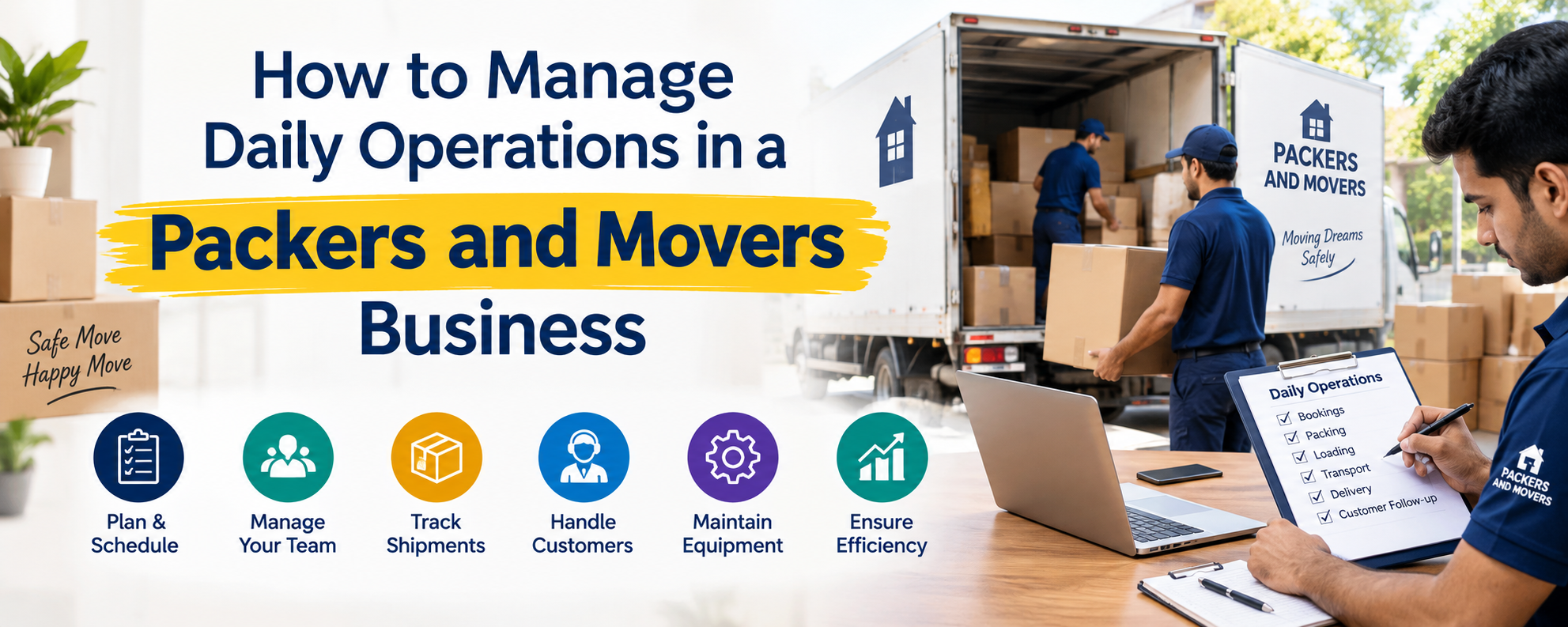
Anyone who has run a packers and movers business for more than a few months knows that the hardest part isn’t getting the work; it’s managing everything that happens once you have it. Operations management of Packers & Movers is indeed challenging on a relatively busy day because there are several things happening at once, such as multiple job orders being executed, various teams working in different areas, client inquiries, vehicle tracking, billing, and complaints, all together at once. The moving company operations management challenge is that all of these things demand attention simultaneously, and without the right systems and structure, important things get missed. Crew members show up to the wrong address. A customer hasn’t been updated on their delivery time. An invoice was never sent. A vehicle is running behind schedule, and nobody told the customer. None of these are the result of a bad team; they’re the result of trying to manage a complex, multi-moving-part operation without adequate tools. This blog is a practical guide to managing daily operations in an Indian packers and movers business: what needs to happen, in what order, and what makes it manageable rather than chaotic.
The Morning – Setting Up the Day Before It Gets Busy
The quality of your daily operations is largely determined by what happens in the first hour of the working day. Moving companies that run well operationally start their day with a structured morning process. Those that don’t spend the rest of the day reacting to problems that could have been anticipated.
Here’s what a well-structured morning operational process looks like:
Review all active jobs for the day. Know exactly how many moves are scheduled, what the pickup and delivery windows are for each, what crew is assigned to each job, and what vehicle is assigned. Identify any conflicts — two jobs starting at the same time that share crew or equipment, or any job with special requirements that haven’t been fully confirmed.
Confirm crew assignments and communicate job details. Every crew member for every job today should receive a clear briefing, customer name, pickup address, delivery address, job start time, any special items to be aware of, and any specific customer instructions. In most Indian moving companies, this happens through a WhatsApp group message. That works, but what works better is a systematic notification through a CRM or operations platform that ensures every crew member has the right information on their phone before they leave for the job.
Confirm vehicle readiness. Every vehicle scheduled for a job today should be confirmed as fuelled, mechanically operational, and carrying the necessary packing materials and equipment for the specific job type. Vehicle problems discovered at 8 am are manageable. Discovered at 9:30 am when the crew is at the customer’s home ready to start — much less so.
Respond to overnight and early morning inquiries. Customer inquiries that came in overnight should be responded to as the first task of the day — not mid-morning when several opportunities have already been lost to competitors who responded first.
Crew Management – The Operational Core
Packers and movers management at the crew level is where most operational problems either originate or are prevented. The crews are the business in operational terms; they are the interface between your company’s promises and the customer’s experience.
Effective daily crew management involves four specific practices:
Clear pre-job briefing. Every team needs to be aware before reaching the client’s place: what items they are moving and where; whether any fragile and valuable things need extra care; the particular requirements and demands of the client; and what they should do if the actual scenario turns out to be something different than the one briefed to them.
Active monitoring during jobs. The operations manager or owner doesn’t need to be on every job, but they do need to know the status of every job in real time. Is the pickup completed? Is the vehicle in transit? Has the delivery started? Are there any issues? This monitoring is what allows problems to be caught and managed before they become crises.
Clear escalation process. Every team member must be aware of whom they need to contact in case of any problem or damage, customer disputes, issues with vehicles, or access problems. The lack of a formalized process where you call the boss whenever there is a problem results in chaotic communication when it is crucial to have organized communication.
Post-job confirmation. Every job must have a formal close: Delivery must be verified; the client’s signature or confirmation secured; all damages or problems recorded; and final billing agreed upon. The formal close avoids the confusion that results in billing disagreements and unsettled customer complaints.
Vehicle and Fleet Management
Vehicle tracking in Indian moving companies is one instance where the difference between good and bad management practices can be seen quite clearly. The mental tracking of a single vehicle is quite easy to accomplish. In the case of a company operating three or more vehicles on simultaneous jobs, this becomes rather difficult.
The operational needs around vehicle management are specific:
Daily vehicle allocation. There is always a definite vehicle allocated for each job, with the allocation considering vehicle capacity versus the volume of work, vehicle availability (scheduling, pre-commitments), and geographic efficiency (the nearest vehicle to pick up the work).
Real-time location awareness. Knowing where each vehicle is during the working day allows the operations team to give customers accurate ETAs, to identify when a job is running behind schedule before it becomes a problem, and to redeploy vehicles efficiently between jobs.
Maintenance scheduling. A vehicle that breaks down on a job day is an operational disaster. Preventive maintenance on a schedule and ensuring vehicles aren’t dispatched when known maintenance is overdue reduces this risk significantly.
Fuel and supplies management. Vehicles should start every job day with adequate fuel and the specific packing materials required for that day’s jobs. This sounds obvious — it’s frequently not checked systematically.
Packers and Movers Operations
The most common source of customer complaints in the Indian moving industry is not damaged items or lateness; it’s communication failure. A customer who isn’t updated on the ETA of their crew, who has to call to find out where their belongings are, or who receives no confirmation of delivery completion has a poor experience regardless of how smoothly the physical move went.
Systematic customer communication throughout the job day means:
Crew dispatch notification. When the crew leaves for the pickup, the customer is notified with the crew’s name and approximate arrival time. This simple step, which in most moving companies doesn’t happen automatically, dramatically reduces the customer anxiety that generates “where is my crew?” calls.
ETA updates when things change. If a job is running late — which happens — the customer should be notified proactively rather than discovering it when the crew hasn’t arrived at the expected time. A proactive “your crew is running approximately 30 minutes behind schedule” message is received very differently from an absent crew with no communication.
Delivery confirmation. When the delivery is complete, the customer should receive a confirmation and an invitation to raise any concerns before the crew leaves. Concerns raised immediately are dramatically easier to resolve than those raised hours or days later.
In a well-structured moving operation, all of this communication can be automated or systematised through a moving company management software platform so it happens consistently for every customer without requiring the operations manager to trigger each message manually.
How to Manage Packers and Movers Business Operations
The administrative side of daily operations- billing, documentation, and records management is where time most often gets lost in Indian moving businesses. Manual processes that could be systematised consume hours that should go toward growth and customer service.
Billing and invoicing. Each job completed should have an invoice generated immediately on its completion date, and not when there is time available for its processing. Delayed invoicing leads to delayed payments and confusion in billing, which communicates to clients that the company lacks organization. Invoicing should be done systematically after each job is completed, especially through an automated CRM system.
Document management. Job moves create forms, contracts, inspection reports, inventories, and delivery receipts. An organized system for document management, including digital when possible, allows access to the documents when needed instead of leaving them buried in WhatsApp messages and unorganized papers.
Review and complaints processing. The end of each working day should include a brief review of any customer feedback received — positive or negative. Positive reviews should be publicly acknowledged, and team members recognised. Complaints should be assessed, actioned where required, and documented for patterns that indicate systemic issues needing to be addressed.
Managing Multiple Jobs Simultaneously
Moving operations for a company running multiple concurrent jobs is the most operationally demanding scenario and the one where informal systems most clearly break down.
The specific challenges of multi-job days:
Priority conflicts when a problem on one job affects resources needed for another — a crew that was supposed to move to a second job after completing the first, a vehicle that’s needed at both locations within overlapping time windows.
Communication overload when the operations manager is fielding calls from multiple crews, multiple customers, and incoming inquiries simultaneously, and important information gets missed or mixed up.
Visibility loss when no single person has an accurate real-time picture of where every crew and every vehicle is and what status each job is at.
The solution to all three challenges is the same: a connected, real-time operational system where every job’s status is visible in a single dashboard, crew updates flow through the system automatically rather than through individual phone calls, and the operations manager can see and respond to the full picture rather than assembling it from fragmented communication.
The Usage of Technology in Packers and Movers Operations Management India
The difference between packers and movers using specialized operations management software and packers and movers using WhatsApp groups, diaries, and brainpower alone will be very large in 2026.
The businesses that manage daily operations most effectively in India are not the ones with the largest teams. They are the ones with the best systems, specifically, systems that automate the routine coordination tasks that consume hours of management time every day, provide real-time visibility into every active job, and ensure systematic customer communication without manual effort.
Packers and Movers CRM systems designed particularly for the Indian moving sector, and not any general-purpose business software tweaked to fit the context, offer the necessary operational features: quick quotation, pipeline management, crew assignment and alerts, job tracking, fleet tracking, automation of customer interaction, and billing management.
Movemitra – Built for Indian Moving Company Operations
Movemitra is the operations and CRM platform built specifically for Indian packers and movers businesses — from the ground up, around the specific operational challenges described in this blog.
Smart scheduling and crew dispatch with real-time notifications. Vehicle and asset tracking. Job status monitoring from inquiry through delivery. Automated customer communication at key job milestones. Professional WhatsApp quotation in under 2 minutes. Systematic follow-up and billing management. And comprehensive reporting that shows you the full business picture — how many active jobs, what stage each is at, where delays are occurring, and what the revenue picture looks like.
The result: 2000+ moving companies across India using Movemitra, 97% customer satisfaction, 60% average revenue growth, and 25+ hours saved in administrative work every week.
For Indian moving companies that want to stop managing operations reactively and start managing them with the visibility and structure that actually produces consistent results, Movemitra is the platform that makes it possible.
FAQs
Here are the FAQ answers shortened while keeping the key information:
Q1. How do I manage daily operations in a packers and movers business?
Use a structured process for crew assignments, vehicle readiness, job tracking, customer updates, billing, and feedback. Moving company operations software can reduce manual work.
Q2. What are the biggest operational challenges for packers and movers in India?
Common challenges include job coordination, customer communication, crew and vehicle management, billing, and complaint handling. Manual tools like WhatsApp and notebooks often make these harder.
Q3. How can a moving company improve crew management?
Give crews clear job details, track job status in real time, set an escalation process, and confirm job completion. Crew management software can make this easier.
Q4. How do I track vehicles in my moving company?
Track vehicle assignments, locations, maintenance, and fuel readiness. GPS and fleet management software provide better visibility.
Q5. What software do packers and movers companies use to manage operations?
Many use moving company CRM and operations software for scheduling, crew dispatch, WhatsApp communication, vehicle tracking, billing, and reporting.
Q6. How can a moving company improve customer communication during moves?
Send timely updates for crew dispatch, delays, transit, and delivery. Automated WhatsApp messaging can handle these updates with less manual work.
Q7. How many jobs can a packers and movers company manage in a day?
It depends on the number of crews, vehicles, and operational systems. Better job tracking and communication can help teams handle more concurrent jobs.
Q8. How does Movemitra help packers and movers manage daily operations?
Movemitra combines job scheduling, crew assignment, vehicle tracking, job status, WhatsApp communication, quotations, and billing in one platform.