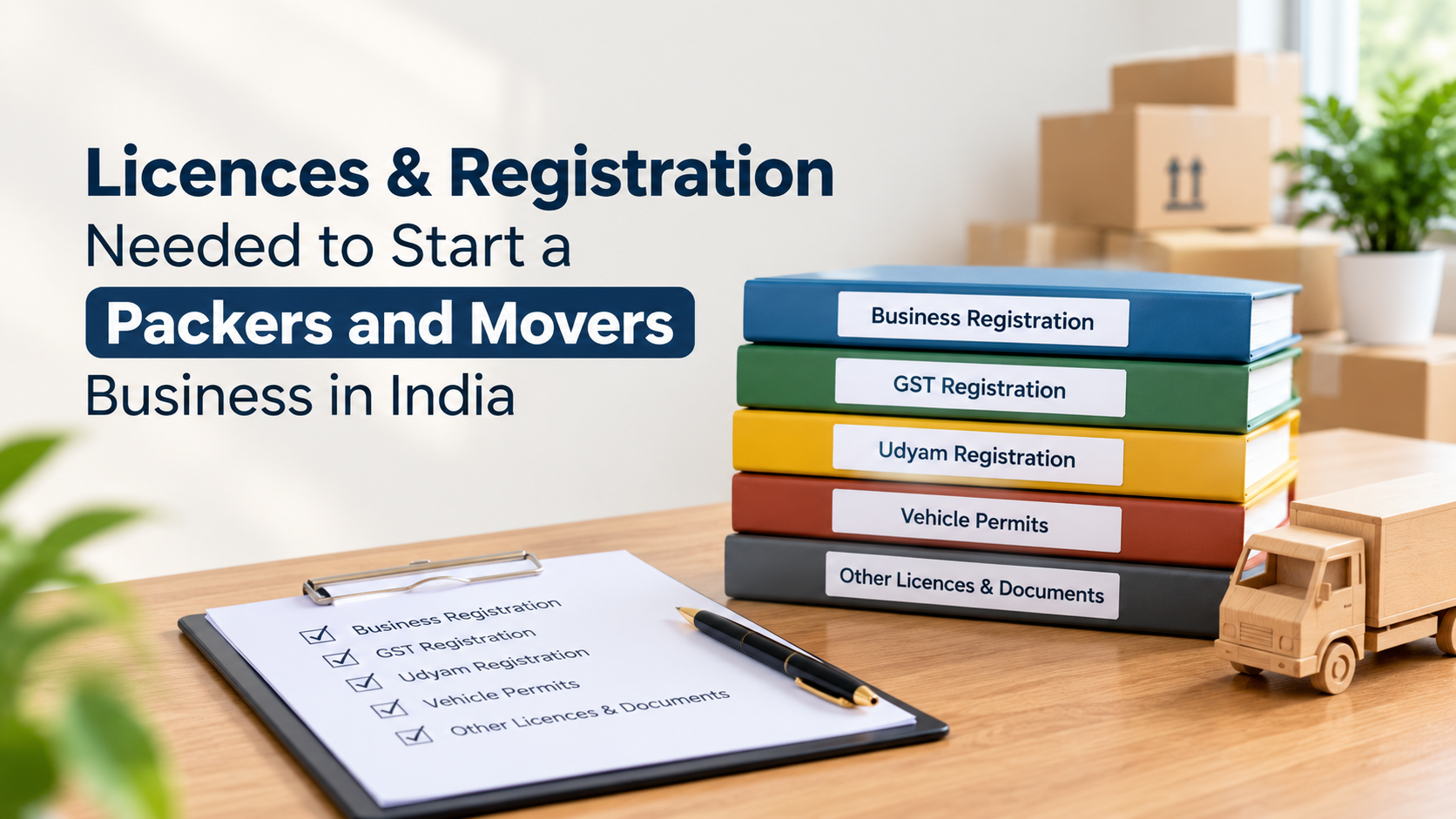
Starting a packers and movers business in India is one of those ventures where the operational side learning how to pack, load, transport, and deliver gets all the attention. In contrast, the legal and Registration side gets treated as something to figure out later. But packers and movers business registration is not optional, and figuring it out later often means operating in a legal grey area that creates real problems when you’re trying to win corporate contracts, when a customer asks for a proper GST invoice, or when authorities stop a vehicle and the paperwork isn’t in order. Getting the licences required for packers and movers in India sorted correctly from the start is one of the most important foundations for building a business that can grow, win professional clients, and operate without compliance surprises that derail otherwise well-run operations. This blog walks through every Registration, licence, and document you need — in plain language, with context for why each one matters.
Why Legal Compliance Matters More Than Most New Operators Realise
Let’s address the elephant in the room first. A significant proportion of the Indian moving industry operates informally: small operators with one or two vehicles who take cash, don’t issue GST invoices, and handle all registrations informally or not at all. You can get work this way, at least initially.
But this approach has a low ceiling. Corporate clients whose HR departments manage employee relocations and require proper documentation won’t engage with unregistered operators. Individual customers who need a legitimate GST invoice for their reimbursement claim will go elsewhere. Banks that could finance your vehicle fleet expansion want to see a registered business with tax filings. Operating without proper documentation puts the risk entirely on you — whether that’s a traffic enforcement issue, an insurance claim that gets denied, or a GST audit.
Operators who build genuine, growing moving businesses in India almost always got the compliance foundation right early.
Packers and Movers Business Licence
1. Business Entity Registration
Your first decision is your business’s legal structure, and it affects taxation, liability, and your ability to scale.
Sole Proprietorship
This is the easiest and most common business structure for a moving company that has just started operations. A sole proprietorship does not require formal Registration, as it runs under the owner’s name and PAN. However, it is important to get Udyam Registration (as mentioned below) and GST Registration once you cross the turnover limits.
Sole proprietorships have no separate legal identity from the owner which means full personal liability for any business obligations. This is acceptable at a small scale but becomes a risk factor as the business grows.
Partnership Firm
When two or more people start a business together, a Partnership Firm is the next step up. Registration with the Registrar of Firms in the relevant state is recommended, though not strictly mandatory. A Partnership Deed is a legal document defining the terms of the partnership, profit-sharing, and responsibilities should be drafted and signed by all partners.
Private Limited Company
For operators planning to scale multiple vehicles, city-wide operations, corporate clients — private limited company registration through the Ministry of Corporate Affairs is the appropriate structure. A private limited company has a separate legal identity, limits directors’ liability, and is significantly more credible to corporate clients and banks.
Registration requires at least two directors, a registered office address, a Memorandum of Association (MoA), and Articles of Association (AoA). The MCA21 portal handles the process.
2. Udyam Registration (MSME Registration)
Udyam registration, the current iteration of MSME (Micro, Small and Medium Enterprise) registration is a government registration that officially classifies your business as a micro, small, or medium enterprise and opens access to various government schemes, priority sector lending, and subsidies.
For a packers and movers business, Udyam registration offers access to government-supported loans for buying vehicles at low interest rates, priority in government tenders, and the legitimacy of being an officially recognised MSME.
Udyam registration is done online on the official Udyam portal (udyamregistration.gov.in)—free of charge, self-certifiable, and linked to Aadhaar and PAN. The process takes under an hour for most applicants.
Classification in 2026:
Micro enterprise: investment up to ₹1 crore and turnover up to ₹5 crore.
Small enterprise: investment up to ₹10 crore and turnover up to ₹50 crore.
Most starting moving companies will initially be classified as micro enterprises.
3. GST Registration
GST registration for packers and movers is mandatory once annual turnover exceeds ₹20 lakhs or ₹10 lakhs in specific special category states. For a growing moving company, this threshold is typically crossed within the first year or two of operation.
Even for businesses below the threshold, voluntary GST registration is often worth considering — because it allows the business to issue packers and movers GST invoice documents that corporate clients and business customers require for input tax credit claims. A moving company that can issue proper GST invoices wins corporate contracts and B2B business that an unregistered company cannot access.
GST registration is completed through the GST portal (gst.gov.in). You’ll need:
PAN card of the business owner or company. Aadhaar card. Business registration documents. Bank account details. Proof of principal place of business (utility bill, lease agreement, or ownership document)—passport-size photograph.
Once registered, your GSTIN appears on every tax invoice you issue. For packers and movers services, the applicable GST rate is 18% — split as 9% CGST and 9% SGST for intrastate moves, or 18% IGST for interstate moves.
4. Shop and Establishment Registration
If your business operates from any physical premises — an office, a warehouse, a booking counter — Shops and Establishments Act registration is required under the relevant state legislation. Every Indian state has its own Shops and Establishments Act, and Registration is with the local municipal authority or labour department depending on the state.
This Registration governs working conditions, employee rights, and business operating hours. For home-based operations, the applicability varies by state — check local requirements.
5. Commercial Vehicle Registration
This is one of the most practical compliance requirements for packers and movers operations and one where many informal operators cut corners, creating serious problems.
Every vehicle used to transport goods commercially must be:
Registered as a commercial vehicle with the Regional Transport Office (RTO) in the relevant state. A vehicle registered for personal use (private category) cannot legally carry commercial goods. Operating a personal vehicle to transport commercial goods is an offence under the Motor Vehicles Act.
Fitted with valid commercial vehicle insurance. Standard personal vehicle insurance explicitly excludes commercial use. An accident involving a privately registered vehicle used to transport commercial goods will typically result in an insurance claim denial, leaving the operator personally liable.
Holding a current Fitness Certificate (FC). Commercial vehicles must undergo periodic fitness inspection at authorised testing stations. The FC verifies that the vehicle meets safety standards.
Road Tax paid. State-specific road tax for commercial vehicles must be current.
For operators buying a new vehicle for their moving business, tell the dealership it will transport commercial goods so they register it in the correct category from the start.
6. Transport Permit
If your moving business will cross state borders—as in intercity and interstate moves— you need a transport permit beyond basic vehicle registration.
For intrastate operations – moves entirely within one state, the vehicle’s commercial Registration from the relevant state RTO is generally sufficient.
For interstate operations – moves that cross state borders vehicles typically require a National Permit issued by the relevant RTO. The National Permit lets commercial vehicles operate across state lines and renews annually.
Without a National Permit for interstate operations, vehicles crossing state borders can be detained at checkpoints, one of the most disruptive and costly compliance failures for moving companies.
Goods Carriage Permit – In addition to the National Permit, vehicles carrying goods commercially may require a Goods Carriage Permit from the state transport authority. Requirements vary by state and vehicle type.
7. IBA Approval
IBA (Indian Banks’ Association) approval is not a legal requirement for all moving companies, but it is a commercial requirement to access a significant corporate client segment.
Many large Indian corporates, particularly banks, insurance companies, and financial institutions, require moving vendors to hold IBA approval before adding them to the approved vendor panel for employee relocation services.
The IBA approval process includes applying for this approval and assessing the company’s capability, insurance coverage, and compliance. This procedure is more complicated than Registration, but IBA approval can bring extra benefits in terms of money and stability.
Documents Required for Packers and Movers Business
Here’s the consolidated documentation checklist:
For the Business Entity:
Business registration papers (Partnership Deed, Certificate of Incorporation, or Udyam certificate). PAN card of the business. Aadhaar card of the owners/directors. Bank account details with a cancelled cheque to prove the registered office address.
For GST:
GSTIN certificate. HSN/SAC code documentation for moving services.
For Vehicles:
RC book for commercial Registration.Registration certificate (latest). Insurance policy of the commercial vehicle. Receipts of road tax. National permit (for inter-state travel). Goods carriage permit (if any). PUC certificate.
For Employment:
EPF (Employees’ Provident Fund) registration — mandatory for businesses with 20 or more employees. ESI (Employees’ State Insurance) registration — mandatory for businesses with 10 or more employees whose wages are below the threshold. You need a labour contractor licence if you engage crew members through a contractor arrangement.
Building the Business Infrastructure Alongside Legal Compliance
Getting registered is the foundation. Building the business systems that let you operate professionally and grow is the next layer, and you should do both at the same time rather than one after the other.
A solid moving company business plan includes not just the registration roadmap but the operational systems: how inquiries are managed, how quotes are generated, how crews are dispatched, how you communicate with customers, and how you track performance.
Systematic moving company sales lead management rather than relying on WhatsApp and memory—separates businesses that convert the compliance investment into actual revenue from those that are legally compliant but still operationally disorganised.
How Movemitra Supports Compliant, Professional Moving Operations
Movemitra is India’s purpose-built CRM for packers and movers, designed to support the operational and commercial infrastructure a properly registered moving company needs.
Prepare GST-compliant quotations in two minutes. Manage the pipeline, no matter where inquiries come from. Schedule jobs and dispatch staff—then bill and invoice after the move. Collect and communicate.
For moving companies with Registration but no matching operational systems, Movemitra provides the business infrastructure that makes professional operations the standard, not the exception.
FAQs
Q1. What registrations does a packers and movers business need in India?
A packers and movers business may need business registration, GST registration, Udyam registration, local trade permissions, and applicable commercial vehicle permits.
Q2. Is GST registration mandatory for packers and movers in India?
GST registration is generally mandatory when the business exceeds the applicable turnover threshold. Voluntary registration is also possible for eligible businesses.
Q3. What GST rate applies to packers and movers services?
The generally applicable GST rate for packers and movers services is 18%, subject to the applicable service classification and tax rules.
Q4. Do moving company vehicles need special registration in India?
Yes. Vehicles used for commercial goods transport need the appropriate commercial registration, fitness certification, insurance, and permits.
Q5. What is Udyam registration and why does a moving company need it?
Udyam registration gives a business official MSME recognition and may provide access to eligible government schemes, financial benefits, and business opportunities.
Q6. What is a National Permit and when does a moving company need it?
A National Permit allows eligible commercial goods vehicles to operate across state borders. It is relevant for moving companies handling interstate transportation.
Q7. What is IBA approval for moving companies in India?
IBA approval is an industry-related vendor recognition that may help moving companies qualify for certain corporate and banking relocation contracts. It is not a universal legal requirement.
Q8. How does MoveMitra help a registered moving company operate professionally?
MoveMitra helps manage leads, generate quotations, schedule jobs, coordinate crews, automate customer communication, and collect customer reviews.

The MoveMitra team shares practical knowledge about the packers and movers industry, business management, CRM software, customer experience, and operational efficiency. Our content helps moving company owners simplify daily tasks and grow their businesses.