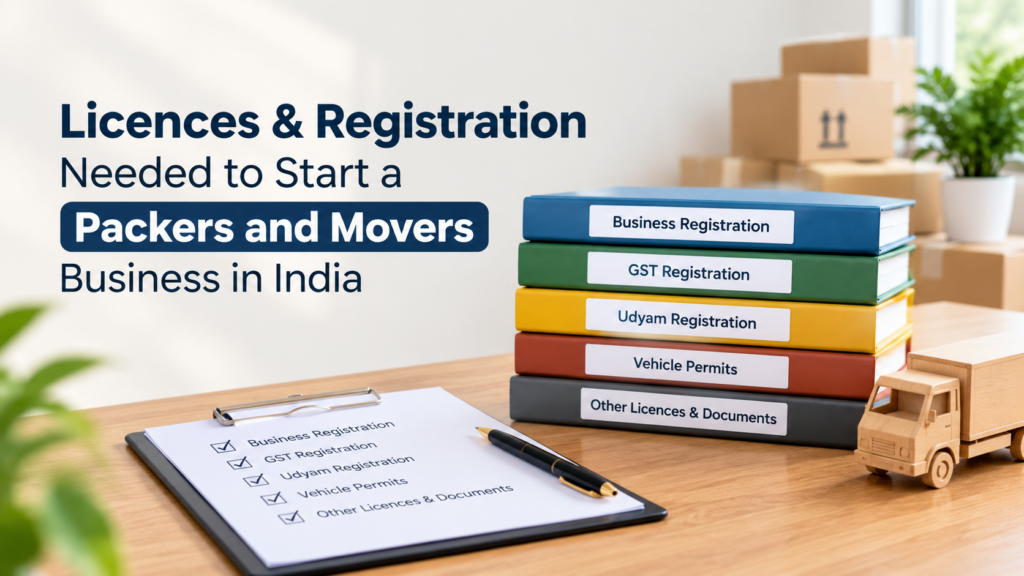
Starting a packers and movers business in India is one of those ventures where the operational side learning how to pack, load, transport, and deliver gets all the attention. In contrast, the legal and Registration side gets treated as something to figure out later. But packers and movers business registration is not optional, and figuring it out later often means operating in a legal grey area that creates real problems when you’re trying to win corporate contracts, when a customer asks for a proper GST invoice, or when authorities stop a vehicle and the paperwork isn’t in order. Getting the licences required for packers and movers in India sorted correctly from the start is one of the most important foundations for building a business that can grow, win professional clients, and operate without compliance surprises that derail otherwise well-run operations. This blog walks through every Registration, licence, and document you need — in plain language, with context for why each one matters. Why Legal Compliance Matters More Than Most New Operators Realise Let’s address the elephant in the room first. A significant proportion of the Indian moving industry operates informally: small operators with one or two vehicles who take cash, don’t issue GST invoices, and handle all registrations informally or not at all. You can get work this way, at least initially. But this approach has a low ceiling. Corporate clients whose HR departments manage employee relocations and require proper documentation won’t engage with unregistered operators. Individual customers who need a legitimate GST invoice for their reimbursement claim will go elsewhere. Banks that could finance your vehicle fleet expansion want to see a registered business with tax filings. Operating without proper documentation puts the risk entirely on you — whether that’s a traffic enforcement issue, an insurance claim that gets denied, or a GST audit. Operators who build genuine, growing moving businesses in India almost always got the compliance foundation right early. Packers and Movers Business Licence 1. Business Entity Registration Your first decision is your business’s legal structure, and it affects taxation, liability, and your ability to scale. Sole Proprietorship This is the easiest and most common business structure for a moving company that has just started operations. A sole proprietorship does not require formal Registration, as it runs under the owner’s name and PAN. However, it is important to get Udyam Registration (as mentioned below) and GST Registration once you cross the turnover limits. Sole proprietorships have no separate legal identity from the owner which means full personal liability for any business obligations. This is acceptable at a small scale but becomes a risk factor as the business grows. Partnership Firm When two or more people start a business together, a Partnership Firm is the next step up. Registration with the Registrar of Firms in the relevant state is recommended, though not strictly mandatory. A Partnership Deed is a legal document defining the terms of the partnership, profit-sharing, and responsibilities should be drafted and signed by all partners. Private Limited Company For operators planning to scale multiple vehicles, city-wide operations, corporate clients — private limited company registration through the Ministry of Corporate Affairs is the appropriate structure. A private limited company has a separate legal identity, limits directors’ liability, and is significantly more credible to corporate clients and banks. Registration requires at least two directors, a registered office address, a Memorandum of Association (MoA), and Articles of Association (AoA). The MCA21 portal handles the process. 2. Udyam Registration (MSME Registration) Udyam registration, the current iteration of MSME (Micro, Small and Medium Enterprise) registration is a government registration that officially classifies your business as a micro, small, or medium enterprise and opens access to various government schemes, priority sector lending, and subsidies. For a packers and movers business, Udyam registration offers access to government-supported loans for buying vehicles at low interest rates, priority in government tenders, and the legitimacy of being an officially recognised MSME. Udyam registration is done online on the official Udyam portal (udyamregistration.gov.in)—free of charge, self-certifiable, and linked to Aadhaar and PAN. The process takes under an hour for most applicants. Classification in 2026: Micro enterprise: investment up to ₹1 crore and turnover up to ₹5 crore. Small enterprise: investment up to ₹10 crore and turnover up to ₹50 crore. Most starting moving companies will initially be classified as micro enterprises. 3. GST Registration GST registration for packers and movers is mandatory once annual turnover exceeds ₹20 lakhs or ₹10 lakhs in specific special category states. For a growing moving company, this threshold is typically crossed within the first year or two of operation. Even for businesses below the threshold, voluntary GST registration is often worth considering — because it allows the business to issue packers and movers GST invoice documents that corporate clients and business customers require for input tax credit claims. A moving company that can issue proper GST invoices wins corporate contracts and B2B business that an unregistered company cannot access. GST registration is completed through the GST portal (gst.gov.in). You’ll need: PAN card of the business owner or company. Aadhaar card. Business registration documents. Bank account details. Proof of principal place of business (utility bill, lease agreement, or ownership document)—passport-size photograph. Once registered, your GSTIN appears on every tax invoice you issue. For packers and movers services, the applicable GST rate is 18% — split as 9% CGST and 9% SGST for intrastate moves, or 18% IGST for interstate moves. 4. Shop and Establishment Registration If your business operates from any physical premises — an office, a warehouse, a booking counter — Shops and Establishments Act registration is required under the relevant state legislation. Every Indian state has its own Shops and Establishments Act, and Registration is with the local municipal authority or labour department depending on the state. This Registration governs working conditions, employee rights, and business operating hours. For home-based operations, the applicability varies by state — check local requirements. 5. Commercial Vehicle Registration This is one of the
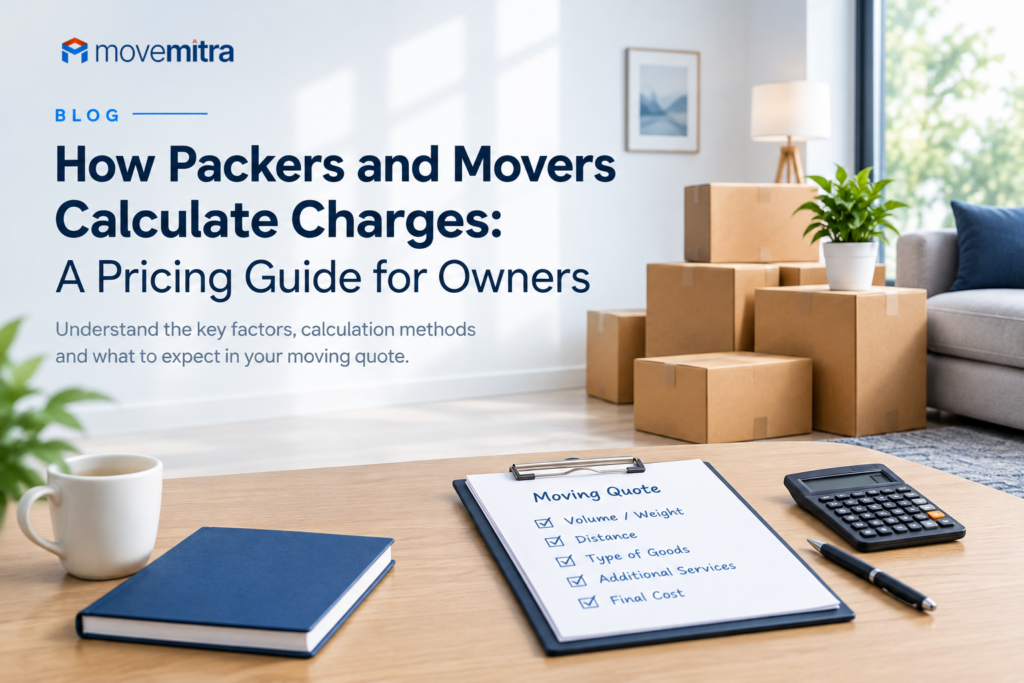
How Packers and Movers Calculate Charges: A Pricing Guide for Owners
One of the most common frustrations that customers have with the Indian moving industry isn’t bad service; it’s confusion about pricing. They get a quote, they accept it, and then the final bill looks different from what they expected. Or they get quotes from three firms that are so disparate that they cannot figure out whether all of them are quoting the same item. But for the movers themselves, it presents a whole new challenge: How do you set rates that are both competitive enough to secure bookings and accurate enough to ensure profitability? Understanding how packers and movers calculate charges, systematically, transparently, and in a way that is defensible to customers is one of the foundational business skills that separates growing moving companies from ones that stay stuck. This packers and movers pricing guide covers every factor that should go into a moving quotation, how to structure your pricing, and how to present it in a way that builds customer confidence rather than creating doubt. Why Pricing in the Moving Industry Is Genuinely Complex Unlike selling a product with a fixed cost, moving services involve a combination of variables that makes every job different. Two customers in the same apartment complex asking for a move to the same destination city might have entirely different final costs because one has a 3BHK full of heavy furniture and the other is a young professional moving with half a dozen boxes and a motorcycle. The best moving company pricing calculation systems account for this variability in a structured, repeatable way so that every quote is calculated consistently, every customer can understand what they’re paying for, and the business always knows whether a job is profitable before committing to it. The Core Variables in Packers and Movers Charges Calculation 1. Volume or Estimated Weight of Goods This is the foundation of almost every moving company’s pricing model. More stuff costs more to move — because it requires more packing materials, more packing time, a larger vehicle, and more loading and unloading labour. Most Indian moving companies assess volume using one of two approaches: Cubic feet or cubic metres. The total volume of packed goods is estimated based on the size and quantity of items — furniture, appliances, boxes, and miscellaneous items. A standard 1BHK apartment typically produces somewhere between 200 and 400 cubic feet of packed goods, depending on furnishing density. A 2BHK ranges from 400 to 700 cubic feet. A 3BHK can range from 600 to 1,200 cubic feet or more. Estimated weight. Certain movers, especially those offering quotes for inter-city or interstate moves where weight is an important determinant of the cost of fuel, tend to quote the price based mainly on the total weight estimate and not the volume of the shipment. In general, 1 cubic foot of packed household items weighs approximately 8-12 kg. As for consumer-oriented quotations, estimation by room with an adjustment according to the amount of furniture actually seen or specified is more realistic than having clients know how to calculate their cubic feet. However, when you price your products, your calculation should be volume-based or weight-based. 2. Distance Packers and movers rate calculation in India varies dramatically by distance category: Local moves – within the same city or within approximately 50 kilometres are typically priced on a flat rate basis by home size, with adjustments for specific complicating factors. Distance within a city is usually not a major pricing variable for local moves. Intercity moves – between cities in the same state are typically priced based on distance in kilometres, applied to a per-kilometre rate that varies by vehicle size. A tempo traveller moving a 1BHK from Bangalore to Mysore (approximately 150 km) will have a different transport cost basis than a 407 truck moving a 3BHK from Bangalore to Hyderabad (approximately 570 km). Interstate moves – crossing state lines introduce additional cost complexity: GST changes from CGST/SGST to IGST, tolls increase, and drivers may require overnight accommodation costs depending on distance. 3. Volume and Type of Goods Beyond total quantity, specific items affect the pricing calculation significantly: Heavy items – refrigerators, washing machines, air conditioners, large sofas, marble dining tables — require additional crew members, specialised handling equipment, or both. These should be quoted as specific line items rather than absorbed into a general rate. Fragile items – glassware, artwork, large mirrors, antiques — require more expensive packing materials, more careful packing time, and potentially specialist crating. The material and labour cost for these items differs substantially from standard household goods. Disassembly and reassembly requirements – beds, wardrobes, modular kitchen components that need to be dismantled at origin and reassembled at destination represent both labour time and skill that should be separately quoted. Plants and pets – not typically moved by professional movers but frequently asked about — if offered as a service, these require specific handling and should be separately priced. 4. Access Conditions at Both Ends This is one of the most consistently underpriced variables in informal Indian moving company quotations — and a frequent source of billing disputes when the final invoice differs from the estimate. Floor access. A third-floor apartment without a lift involves significant additional manual labour compared to a ground-floor home. Every floor of stairs above the ground floor adds meaningful time and physical demand to the crew’s work. Stair access charges should be clearly factored into every quote where applicable. Elevator availability and size. A functioning, adequately sized freight elevator dramatically changes the loading and unloading time compared to stairs or a small passenger elevator. Access conditions should be confirmed before generating the quotation. Parking and loading proximity. A home with direct vehicle access to the loading area is significantly more efficient than one requiring goods to be carried 50 metres along a footpath or through a housing society gate with restricted vehicle access. Destination access. The same access considerations apply at the delivery end, and they’re not always the same as the pickup end. A
Packers and Movers Business Plan in India (2026): Investment, Profit Margins & Operating Model
If you’ve been thinking about starting a moving company in India or if you already run one and want to build it more systematically, the first thing you need is a clear, realistic picture of what the business actually looks like from the inside. A packers and movers business plan is not a mere piece of paper that you write when applying for funding from banks. A business plan will define how your business will succeed in the future or fail to make a difference at all. The Indian relocation market is growing — urbanisation, job mobility, and corporate transfers are all driving consistent demand for professional moving services, and the packers and movers business opportunity is genuinely significant for operators who approach it with the right structure. The investment needed for such a venture, profit margins at varying scales, and the operational framework needed to ensure sustainability in the business will be outlined in this blog post for 2026. Why Most Moving Businesses in India Struggle to Scale Before getting into the plan itself, it’s worth being honest about why many Indian moving businesses plateau at a certain revenue level and never break through, because understanding this changes how you approach the planning. The majority of Indian moving companies are founded by people with prior experience in logistics/transportation who are adept at operations related to moving, like packing, loading, driving, and delivery. What they generally lack is the infrastructure for their business that helps them grow through systematic lead management, a professional quotation system, management of crew/operations, financials, and communication with customers. This results in a company that works when the owner is personally involved in every single aspect, from personal management of all the work to talking to all clients, but one that cannot scale beyond what one person can oversee. The revenues stop growing, and the owner is tired—every attempt to increase sales leads to chaos. A proper moving company business plan addresses both dimensions- the operational and the business infrastructure because growth requires both. The Indian Relocation Market in 2026 Yes. The demand fundamentals are genuinely strong. The urban population of India keeps growing, with millions of individuals migrating every year for work opportunities, educational needs, and lifestyle purposes. The corporate migration process involves the movement of corporate employees between cities and provides a steady flow of lucrative moves. The housing boom in the tier-1 and tier-2 cities creates a steady flow of customers looking for house moving services. The rising trend towards hiring professional services for moving and not opting for truck-based services is helping the moving firms. The particular opportunity in 2026 is to take advantage of the difference between the expectations of customers and what the majority of Indian moving companies can provide. Customers now have increasing expectations for professional communication, clear pricing, prompt service, and responsibility, and the companies that can provide all of this are quickly growing, leaving the informal companies behind. How to Start a Packers and Movers Business in India Legal Structure and Registration Packers and movers registration involves several components that form the legal foundation of the business. Business registration. For a sole proprietorship, the simplest structure for a single owner starting, Udyam registration (previously MSME registration) provides official business recognition and access to government schemes. For a partnership or private limited company, a more appropriate structure as the business grows; appropriate registration with the Ministry of Corporate Affairs is required. GST registration. Any moving company with annual turnover exceeding ₹20 lakhs must register for GST. Given that a growing moving company will typically reach this threshold within the first year or two, GST registration from the outset is the recommended approach. GST registration also gives the business credibility with commercial and corporate clients who require a GSTIN on invoices for input tax credit. Shops and Establishments registration. Required for any business premises and generally straightforward to obtain from the relevant state authority. Vehicle documentation. All commercial vehicles used for moving goods require appropriate commercial registration, fitness certificates, and insurance. A vehicle registered for personal use cannot legally carry commercial loads — this is a compliance point that informal operators frequently overlook, and that creates significant liability exposure. IBA approval. For moving companies that want to access corporate relocation contracts — particularly with major Indian companies whose HR departments require pre-approved vendor panels — approval from the Indian Banks’ Association (IBA) framework is relevant. While not mandatory for general consumer moving, IBA-approved status opens access to a significant corporate client segment. Packers and Movers Startup Cost India The investment required to start a professional moving company varies significantly based on scale and whether you’re leasing or purchasing vehicles. Here’s a realistic breakdown: Small-scale start (1 vehicle, local operations): One commercial vehicle (leased): ₹15,000 to ₹25,000 per month in lease costs, or ₹8 to ₹15 lakhs for outright purchase of a used commercial vehicle. Packing materials (initial stock): ₹50,000 to ₹1,00,000. Basic equipment (trolleys, moving blankets, straps): ₹30,000 to ₹60,000. Registration and compliance costs: ₹30,000 to ₹50,000. Working capital (first 3 months of operations): ₹1,00,000 to ₹2,00,000. Office setup (minimal can be home-based initially): ₹0 to ₹50,000. Marketing and digital presence (website, Google Business Profile, platform registrations): ₹30,000 to ₹80,000. Total estimated startup cost (small scale, vehicle lease): ₹2,40,000 to ₹5,30,000 Mid-scale start (2-3 vehicles, city-wide operations): 2 to 3 vehicles: Rs. 15 to 30 lakhs (purchase) or Rs. 40,000 to 70,000 per month (leasing). Equipment and packing materials: Rs. 1,50,000 to Rs. 2,50,000. Crew members: 4 to 6 (salary for 3 months): Rs. 1,80,000 to Rs. 3,60,000. Office space rental for one year (advance): Rs. 60,000 to Rs. 1,50,000. Other compliance costs: Rs. 1,00,000 to 2,00,000. Total estimated startup cost (mid-scale, vehicle purchase): ₹20 to ₹40 lakhs Packers and Movers Business Model A moving company generates revenue through several interconnected streams, and understanding each one helps in building a realistic financial model. Core moving service revenue. The primary revenue stream charges for the complete moving service, including