One of the most common frustrations that customers have with the Indian moving industry isn’t bad service; it’s confusion about pricing. They get a quote, they accept it, and then the final bill looks different from what they expected. Or they get quotes from three firms that are so disparate that they cannot figure out whether all of them are quoting the same item. But for the movers themselves, it presents a whole new challenge: How do you set rates that are both competitive enough to secure bookings and accurate enough to ensure profitability? Understanding how packers and movers calculate charges, systematically, transparently, and in a way that is defensible to customers is one of the foundational business skills that separates growing moving companies from ones that stay stuck. This packers and movers pricing guide covers every factor that should go into a moving quotation, how to structure your pricing, and how to present it in a way that builds customer confidence rather than creating doubt. Why Pricing in the Moving Industry Is Genuinely Complex Unlike selling a product with a fixed cost, moving services involve a combination of variables that makes every job different. Two customers in the same apartment complex asking for a move to the same destination city might have entirely different final costs because one has a 3BHK full of heavy furniture and the other is a young professional moving with half a dozen boxes and a motorcycle. The best moving company pricing calculation systems account for this variability in a structured, repeatable way so that every quote is calculated consistently, every customer can understand what they’re paying for, and the business always knows whether a job is profitable before committing to it. The Core Variables in Packers and Movers Charges Calculation 1. Volume or Estimated Weight of Goods This is the foundation of almost every moving company’s pricing model. More stuff costs more to move — because it requires more packing materials, more packing time, a larger vehicle, and more loading and unloading labour. Most Indian moving companies assess volume using one of two approaches: Cubic feet or cubic metres. The total volume of packed goods is estimated based on the size and quantity of items — furniture, appliances, boxes, and miscellaneous items. A standard 1BHK apartment typically produces somewhere between 200 and 400 cubic feet of packed goods, depending on furnishing density. A 2BHK ranges from 400 to 700 cubic feet. A 3BHK can range from 600 to 1,200 cubic feet or more. Estimated weight. Certain movers, especially those offering quotes for inter-city or interstate moves where weight is an important determinant of the cost of fuel, tend to quote the price based mainly on the total weight estimate and not the volume of the shipment. In general, 1 cubic foot of packed household items weighs approximately 8-12 kg. As for consumer-oriented quotations, estimation by room with an adjustment according to the amount of furniture actually seen or specified is more realistic than having clients know how to calculate their cubic feet. However, when you price your products, your calculation should be volume-based or weight-based. 2. Distance Packers and movers rate calculation in India varies dramatically by distance category: Local moves – within the same city or within approximately 50 kilometres are typically priced on a flat rate basis by home size, with adjustments for specific complicating factors. Distance within a city is usually not a major pricing variable for local moves. Intercity moves – between cities in the same state are typically priced based on distance in kilometres, applied to a per-kilometre rate that varies by vehicle size. A tempo traveller moving a 1BHK from Bangalore to Mysore (approximately 150 km) will have a different transport cost basis than a 407 truck moving a 3BHK from Bangalore to Hyderabad (approximately 570 km). Interstate moves – crossing state lines introduce additional cost complexity: GST changes from CGST/SGST to IGST, tolls increase, and drivers may require overnight accommodation costs depending on distance. 3. Volume and Type of Goods Beyond total quantity, specific items affect the pricing calculation significantly: Heavy items – refrigerators, washing machines, air conditioners, large sofas, marble dining tables — require additional crew members, specialised handling equipment, or both. These should be quoted as specific line items rather than absorbed into a general rate. Fragile items – glassware, artwork, large mirrors, antiques — require more expensive packing materials, more careful packing time, and potentially specialist crating. The material and labour cost for these items differs substantially from standard household goods. Disassembly and reassembly requirements – beds, wardrobes, modular kitchen components that need to be dismantled at origin and reassembled at destination represent both labour time and skill that should be separately quoted. Plants and pets – not typically moved by professional movers but frequently asked about — if offered as a service, these require specific handling and should be separately priced. 4. Access Conditions at Both Ends This is one of the most consistently underpriced variables in informal Indian moving company quotations — and a frequent source of billing disputes when the final invoice differs from the estimate. Floor access. A third-floor apartment without a lift involves significant additional manual labour compared to a ground-floor home. Every floor of stairs above the ground floor adds meaningful time and physical demand to the crew’s work. Stair access charges should be clearly factored into every quote where applicable. Elevator availability and size. A functioning, adequately sized freight elevator dramatically changes the loading and unloading time compared to stairs or a small passenger elevator. Access conditions should be confirmed before generating the quotation. Parking and loading proximity. A home with direct vehicle access to the loading area is significantly more efficient than one requiring goods to be carried 50 metres along a footpath or through a housing society gate with restricted vehicle access. Destination access. The same access considerations apply at the delivery end, and they’re not always the same as the pickup end. A

Packers and Movers Business Plan in India (2026): Investment, Profit Margins & Operating Model
If you’ve been thinking about starting a moving company in India or if you already run one and want to build it more systematically, the first thing you need is a clear, realistic picture of what the business actually looks like from the inside. A packers and movers business plan is not a mere piece of paper that you write when applying for funding from banks. A business plan will define how your business will succeed in the future or fail to make a difference at all. The Indian relocation market is growing — urbanisation, job mobility, and corporate transfers are all driving consistent demand for professional moving services, and the packers and movers business opportunity is genuinely significant for operators who approach it with the right structure. The investment needed for such a venture, profit margins at varying scales, and the operational framework needed to ensure sustainability in the business will be outlined in this blog post for 2026. Why Most Moving Businesses in India Struggle to Scale Before getting into the plan itself, it’s worth being honest about why many Indian moving businesses plateau at a certain revenue level and never break through, because understanding this changes how you approach the planning. The majority of Indian moving companies are founded by people with prior experience in logistics/transportation who are adept at operations related to moving, like packing, loading, driving, and delivery. What they generally lack is the infrastructure for their business that helps them grow through systematic lead management, a professional quotation system, management of crew/operations, financials, and communication with customers. This results in a company that works when the owner is personally involved in every single aspect, from personal management of all the work to talking to all clients, but one that cannot scale beyond what one person can oversee. The revenues stop growing, and the owner is tired—every attempt to increase sales leads to chaos. A proper moving company business plan addresses both dimensions- the operational and the business infrastructure because growth requires both. The Indian Relocation Market in 2026 Yes. The demand fundamentals are genuinely strong. The urban population of India keeps growing, with millions of individuals migrating every year for work opportunities, educational needs, and lifestyle purposes. The corporate migration process involves the movement of corporate employees between cities and provides a steady flow of lucrative moves. The housing boom in the tier-1 and tier-2 cities creates a steady flow of customers looking for house moving services. The rising trend towards hiring professional services for moving and not opting for truck-based services is helping the moving firms. The particular opportunity in 2026 is to take advantage of the difference between the expectations of customers and what the majority of Indian moving companies can provide. Customers now have increasing expectations for professional communication, clear pricing, prompt service, and responsibility, and the companies that can provide all of this are quickly growing, leaving the informal companies behind. How to Start a Packers and Movers Business in India Legal Structure and Registration Packers and movers registration involves several components that form the legal foundation of the business. Business registration. For a sole proprietorship, the simplest structure for a single owner starting, Udyam registration (previously MSME registration) provides official business recognition and access to government schemes. For a partnership or private limited company, a more appropriate structure as the business grows; appropriate registration with the Ministry of Corporate Affairs is required. GST registration. Any moving company with annual turnover exceeding ₹20 lakhs must register for GST. Given that a growing moving company will typically reach this threshold within the first year or two, GST registration from the outset is the recommended approach. GST registration also gives the business credibility with commercial and corporate clients who require a GSTIN on invoices for input tax credit. Shops and Establishments registration. Required for any business premises and generally straightforward to obtain from the relevant state authority. Vehicle documentation. All commercial vehicles used for moving goods require appropriate commercial registration, fitness certificates, and insurance. A vehicle registered for personal use cannot legally carry commercial loads — this is a compliance point that informal operators frequently overlook, and that creates significant liability exposure. IBA approval. For moving companies that want to access corporate relocation contracts — particularly with major Indian companies whose HR departments require pre-approved vendor panels — approval from the Indian Banks’ Association (IBA) framework is relevant. While not mandatory for general consumer moving, IBA-approved status opens access to a significant corporate client segment. Packers and Movers Startup Cost India The investment required to start a professional moving company varies significantly based on scale and whether you’re leasing or purchasing vehicles. Here’s a realistic breakdown: Small-scale start (1 vehicle, local operations): One commercial vehicle (leased): ₹15,000 to ₹25,000 per month in lease costs, or ₹8 to ₹15 lakhs for outright purchase of a used commercial vehicle. Packing materials (initial stock): ₹50,000 to ₹1,00,000. Basic equipment (trolleys, moving blankets, straps): ₹30,000 to ₹60,000. Registration and compliance costs: ₹30,000 to ₹50,000. Working capital (first 3 months of operations): ₹1,00,000 to ₹2,00,000. Office setup (minimal can be home-based initially): ₹0 to ₹50,000. Marketing and digital presence (website, Google Business Profile, platform registrations): ₹30,000 to ₹80,000. Total estimated startup cost (small scale, vehicle lease): ₹2,40,000 to ₹5,30,000 Mid-scale start (2-3 vehicles, city-wide operations): 2 to 3 vehicles: Rs. 15 to 30 lakhs (purchase) or Rs. 40,000 to 70,000 per month (leasing). Equipment and packing materials: Rs. 1,50,000 to Rs. 2,50,000. Crew members: 4 to 6 (salary for 3 months): Rs. 1,80,000 to Rs. 3,60,000. Office space rental for one year (advance): Rs. 60,000 to Rs. 1,50,000. Other compliance costs: Rs. 1,00,000 to 2,00,000. Total estimated startup cost (mid-scale, vehicle purchase): ₹20 to ₹40 lakhs Packers and Movers Business Model A moving company generates revenue through several interconnected streams, and understanding each one helps in building a realistic financial model. Core moving service revenue. The primary revenue stream charges for the complete moving service, including
How to Reduce Customer Complaints in a Packers and Movers Business: 7 Proven Strategies
Every packers and movers business owner has been there, a customer who seemed perfectly satisfied during the move calls two days later with a complaint. Or worse, they don’t call at all, but they leave a one-star Google review that every future potential customer is going to see before deciding whether to book with you. Customer complaints in packers and movers businesses are one of the most significant factors affecting growth, not just because they’re unpleasant to deal with, but because in the age of public reviews and social media, a pattern of complaints is visible to future customers before they’ve even spoken to you. The encouraging reality is that the majority of packers and movers customer complaints don’t originate from actual bad moves. These emerge from communication breakdowns, expectation gaps, and procedural flaws, which can be easily rectified with the right method. This blog describes the seven particular methods that will help to minimize complaints among Indian moving companies and explains how each of them solves the real problem rather than the symptom. Understanding Where Complaints Actually Come From Before getting into strategies, it’s worth being specific about what Indian moving company customers actually complain about — because the answer is different from what most moving company owners assume. When you look at the Google reviews and customer feedback that Indian packers and movers businesses receive, the pattern is revealing. A relatively small proportion of complaints are about actual physical damage to items during the move. The large majority are about communication specifically, the absence of it at moments when the customer needed reassurance. The crew was two hours late, and nobody had bothered to call them a warning about that. The customer attempted to contact someone once the move was done in order to ask a question, but they couldn’t manage that. The invoice was not like the one that was quoted. Nobody ever confirmed the booking after it was made. In every one of these cases, the move itself may have been perfectly executed, boxes moved, nothing broken, delivery completed. But the customer’s experience of the service was poor because of the gaps in communication surrounding the move. And in the Indian context, where word of mouth and online reviews are the primary trust signals new customers use to choose a moving company, a complaint driven by communication failure costs exactly as much revenue as a complaint driven by a damaged item. This is important because it means most complaints are preventable — not by hiring better movers, but by building better systems. Strategy 1: Set Crystal Clear Expectations Before the Move The foundation of customer satisfaction for packers and movers is ensuring that what the customer expects is exactly what they experience. When there is a gap between expectation and reality even when the reality itself is fine, a complaint is likely. The most common expectation gaps in Indian moving companies: The customer expected the crew at 9 am. The crew arrived at 11 am. Nobody told them there would be a delay. The customer expected the move to cost ₹12,000. The final bill was ₹15,000 because of additional charges that were in the quote but were never specifically explained. The customer expected careful handling of fragile items. The crew did handle them carefully, but the customer wasn’t told how they would be packed and was surprised by the packing method. These gaps result in complaints regardless of whether the underlying service was satisfactory. The way to eliminate such gaps is through a structured pre-move briefing on: precise confirmed time of arrival, full cost breakdown and what causes the variable costs, what the packing procedure will be depending on the type of items being packed, how long the move is expected to take, and whom to contact in case of any issue during the move. This briefing — delivered as a structured WhatsApp message or phone call 24 hours before the move — prevents the majority of post-move complaints before the move even begins. Strategy 2: Communicate Proactively During the Move Packers and movers customer service that reduces complaints specifically includes the moments of communication that happen between booking confirmation and delivery completion not just at the start and end of the process. The most anxiety-producing situation for a moving customer is uncertainty. They don’t know where their crew is. They don’t know if something went wrong. They don’t know when to expect delivery. This uncertainty generates calls to your team, frustration when those calls go unanswered, and the low-grade anxiety that colours their entire experience of the service. Proactive communication during the move eliminates this uncertainty systematically: A notification when the crew departs for the pickup — with the crew leader’s name and approximate arrival time. An update when the truck is loaded and in transit. An ETA message when delivery is 30 to 60 minutes away. A completion message when delivery is finished, with an invitation to raise any concerns before the crew leaves. Each of these messages takes seconds to send and eliminates hours of customer anxiety. They’re not difficult to produce, but they need to become a systematic part of every job, not something individual crew members do when they remember. CRM with WhatsApp integration that automates these milestone communications ensures they happen consistently for every job not just the ones where the coordinator had time to think about it. Strategy 3: Create a Clear and Transparent Billing Process The customer experience for moving companies is disproportionately shaped by the billing moment — both at the quotation stage and at the final invoice stage. Billing surprises are among the most reliably complaint-generating experiences in the moving industry. The billing-related complaints that moving companies receive most frequently: The final invoice was higher than the quoted price without a clear explanation of why. There were charges on the invoice that the customer didn’t know would apply. The customer was asked for cash payment and didn’t have the right amount available because they expected
How to Convert More Packers and Movers Leads Into Bookings
Getting inquiries is not the hard part. Most packers and movers businesses in India receive a reasonable volume of packers and movers lead conversion opportunities every week: customers who reached out, expressed genuine interest, and asked for a quote. The hard part is converting those inquiries into confirmed bookings before a competitor does. If you’re looking at your inquiry volume and your booking numbers and the gap between them feels larger than it should be, you’re experiencing the most common and most costly challenge in the Indian moving industry. This blog is about closing that gap specifically: the practical improvements in your moving company’s management process that consistently produce higher conversion rates without requiring more marketing spend or more inquiries. Understanding Why Conversion Fails The instinct when bookings are lower than expected is to look for more leads, to spend more on advertising, to be on more platforms, to generate more inquiries. But if the conversion process is broken, more leads produce more missed opportunities rather than more bookings. The most important investment you can make in booking growth is fixing the conversion process first. Packers and movers lead management fails at several specific, identifiable points. Identifying which ones are most active in your business is the first step toward fixing them. The inquiry comes in, and the response is slow; the customer has already received a quote from a competitor and moved on by the time you follow up. The quote you send is unclear, incomplete, or formatted in a way that creates doubt rather than confidence. The customer receives the quote, shows interest, and then never hears from you again until they’ve already booked elsewhere. The customer had a question that nobody answered promptly enough. The customer wasn’t given a clear, easy next step after receiving the quote. These are all holes in the selling process, not a measure of service or price. The companies that get the highest conversions in the Indian moving business aren’t necessarily the cheapest or the most knowledgeable. They are the quickest, the most professional, and the most organized. The Conversion Factor Nobody Talks About Enough Before getting into tactics, it’s important to understand the single factor that has the most influence on moving company lead conversion rates: response speed. In the Indian moving market, most customers send inquiries to two or three companies at the same time. They are actively comparing. The company that responds first with a professional, complete quote wins a disproportionate share of bookings — not because their price is lower or their service is demonstrably better, but because they were first. The customer who received your competitor’s professional quote 20 minutes ago and your quote two hours later is already leaning toward the competitor before they’ve even opened yours. The human psychology of this is straightforward: the company that responded quickly feels more organised, more professional, and more reliable. Subconsciously, the customer is already making a judgment about which company will be more reliable on move day. Every minute between an inquiry arriving and a professional quote being sent is a minute the conversion window is closing. This is the most direct argument for systematising the quotation process, because a quote that takes two minutes instead of 40 minutes produces more bookings without any other change. Step 1: Respond With a Professional Quote Within 15 Minutes This is the conversion improvement with the highest immediate impact — and it’s available to every moving company regardless of team size or budget. The challenge is that generating a proper moving quote manually — calculating the volume, the distance, the vehicle type, the packing requirements, and the labour takes time. And during busy periods, it takes time you don’t have. The result is delayed responses that lose bookings. WhatsApp sales conversion for packers and movers happens fastest when the quote generation process is systematised. A defined pricing structure for common move types, a professional quote template, and a tool that generates and sends the quote through WhatsApp in a streamlined process — rather than manual calculation, manual formatting, and manual copy-pasting — compresses the response time dramatically. The goal is a complete, professional WhatsApp quote within 15 minutes of every inquiry. Achieving this consistently — not occasionally when things are quiet, but consistently as a standard — is one of the highest-leverage conversion improvements available. Step 2: Make the Quote Do the Selling A quote is not just a price. It’s the first detailed communication a potential customer receives about your company — and it shapes their perception of your professionalism before they’ve interacted with a single person from your team. How to convert packers and movers leads into bookings through the quotation document itself means ensuring that every quote communicates: Complete, itemised costs with no hidden-fee ambiguity. What’s included and what isn’t, clearly stated. Your company name and branding — not a generic number. A professional format that looks organised and trustworthy — not a rough calculation. A clear next step — “Reply YES to confirm your booking” or “Call us on this number to discuss.” The customer receiving your quote is also evaluating whether they trust you with their furniture, their appliances, and the belongings they’ve accumulated over years. A professional, complete, clearly formatted quote says your company is organised, transparent, and competent. A rough WhatsApp message with a number says the opposite. Step 3: Follow Up on Day Two This is where most packers and movers sales process improvements produce the fastest visible results because most Indian moving companies are not doing this consistently, and the revenue from systematic follow-up is genuinely significant. The customer you quoted and who hasn’t replied to your message right away isn’t necessarily uninterested. They may just be considering different offers. They may have wanted to reply but got distracted somehow. They may want to check when exactly they’ll be moving to decide on the offer they’ve already decided on. The company that sends a brief, professional follow-up WhatsApp message on day
How to Manage GST Invoices for Packers and Movers in India
Running a packers and movers business in India involves a lot more than just moving boxes from one address to another. Behind every move is a financial transaction that needs to be documented correctly, and since GST came into force, that documentation has become both more important and more specific. If you’ve been struggling with GST invoice requirements for packers and movers or if you’re not entirely sure whether what you’re currently issuing meets the legal standard, you’re not alone. Packers and movers GST invoice compliance is one of the most commonly misunderstood administrative aspects of running a moving company in India, and getting it wrong creates problems that range from customer disputes to tax department scrutiny. This blog walks you through everything you need to know — the GST structure for moving services, what a compliant invoice must include, common mistakes to avoid, and how the right billing software makes the whole process significantly less painful. GST and the Moving Industry Before getting into invoices specifically, it helps to understand how GST applies to packers and movers services in India because the structure is not entirely straightforward. In India, moving and relocation services fall under the ambit of GST as transportation of goods, for which GST will be applicable at 18%, if all four aspects – packing, loading, transport, and unloading of goods are done together in the provision of such a service. In case the moving and relocation services are split into various services, then different rates will apply. The GST rate applicable to your specific service type should be confirmed with a qualified tax professional or chartered accountant, because the classification and rate have practical implications for how you structure your invoicing and your GST returns. The broad 18% rate applies to the majority of full-service packers and movers engagements, but understanding exactly which SAC (Service Accounting Code) applies to your service type is essential before you begin issuing GST invoices. GST registration is mandatory for packers and movers businesses whose annual turnover exceeds the threshold, currently ₹20 lakhs for most states (₹10 lakhs for certain special category states). If your turnover is below this threshold, you are not required to register for GST, but you also cannot issue GST invoices or charge GST to customers. If you’ve exceeded the threshold and haven’t registered yet, that needs to be your immediate priority. What a Compliant Packers and Movers GST Invoice Must Include A GST billing for packers and movers invoice that doesn’t include all the legally required elements is not a valid GST invoice, which means your customer cannot claim input tax credit on it, and you could face issues during a GST audit. Here are the mandatory fields: Your business details. Your registered business name exactly as it appears in your GST registration, your GSTIN (GST Identification Number), and your registered business address must all appear on every invoice. Invoice number and date. Each invoice must have a unique serial number and the date of issue. Invoice numbers must be sequential within a financial year — you cannot reuse numbers or have gaps without a valid reason. Customer details: the customer’s name and address. If the customer is a business that wants to claim input tax credit, their GSTIN must also appear on the invoice. Service description. A clear description of the service provided — in the context of a moving company, this typically includes the nature of the move (local or interstate), the pickup and delivery addresses, and a description of the services included (packing, loading, transportation, unloading, etc.). SAC (Service Accounting Code). The specific SAC code applicable to the service being billed. For most full-service moving and packing services, this is 996713, but verify this with your accountant for your specific service type. Taxable value. The value of the service before GST is applied. GST breakdown. For services provided within the same state, this means the CGST amount and SGST amount separately, each at half the total GST rate. For services that cross state lines, this means the IGST amount. The distinction between intrastate and interstate is important — apply the wrong tax type, and you’ve issued an incorrect invoice that may need to be cancelled and reissued. Total invoice value. The total amount payable, including GST, clearly stated. Payment terms and details. The payment due date and bank transfer details where applicable. Intrastate vs Interstate Moves – Why It Matters for GST This is one of the most practically important GST distinctions for moving companies and one that many smaller operators handle incorrectly. When a move takes place within the same state, from one location to another within Karnataka, for example, the GST is split equally between CGST (Central GST) and SGST (State GST). For an 18% total rate, this means 9% CGST and 9% SGST. When a move crosses state lines from Karnataka to Maharashtra, for example, the applicable tax is IGST (Integrated GST) at the full 18%, rather than the split CGST/SGST structure. The practical implications for your invoicing are significant. If you apply CGST and SGST to an interstate move, you’ve issued an incorrect invoice. If you apply IGST to an intrastate move, you’ve also issued an incorrect invoice. Either error creates complications for your GST returns and for your customer’s input tax credit claims. Train whoever handles your invoicing to correctly identify whether each job is intrastate or interstate before generating the invoice, and ensure your invoicing template or software handles both scenarios accurately. GST Invoice for Moving Company – Common Mistakes to Avoid Having reviewed GST invoices from many moving companies, the same errors appear consistently. Here’s what to watch for: Missing or incorrect GSTIN. Your own GSTIN appearing incorrectly — a single-character error — creates an invalid invoice. Check this meticulously on every invoice template and update immediately if your registration details change. Using a single invoice format for both intrastate and interstate. Many moving companies use one template for all invoices and manually add either
How Packers and Movers Can Reduce Delays With Better Crew Coordination
If you own a packers and movers company in India, then you must be aware of the experience. You have the truck fully loaded, the customer is waiting at his new location, and some way or the other, half of your team is still at the old location due to the simple reason that they were not informed that the loading process was delayed. This is not mere bad luck. This is the consequence of crew management of packers and movers by relying on calls and WhatsApp messages and the power of memory alone. Delays rarely happen because your team is lazy or careless. They happen because information does not travel fast enough between the office, the driver, the loaders, and the customer. By the time someone realizes there is a problem, the truck is already an hour behind schedule. Why Moving Jobs Get Delayed in the First Place Before fixing the problem, it helps to understand where things actually go wrong. Most operational delays in this industry come from a handful of repeat offenders. No clear job briefing. Crews often show up to a site without knowing the full scope of the job, whether there is a lift available, how many floors they are dealing with, or whether the customer has any special items like a piano or an aquarium. This leads to on-site confusion and lost time. Overlapping schedules. When job assignments are managed on a whiteboard or a group chat, it is easy to double-book a crew or a vehicle without anyone noticing until the morning of the move. Poor visibility for the office team. The person coordinating from the back office often has no real way to know where a crew is at any given moment. They are relying on someone picking up a phone call, and calls get missed during a heavy loading job. Last-minute crew changes. Someone falls sick, a vehicle breaks down, or a job runs longer than planned, and now the next job in line is short-staffed with no backup plan ready. Each of these on its own seems small. Together, they are exactly why packers and movers operational delays keep piling up week after week, quietly eating into both revenue and reputation. What Good Crew Coordination Actually Looks Like A well-run moving company does not avoid delays because it never runs into problems. It avoids delays because problems get spotted and solved before the customer even notices. That difference comes down to how well the crew, the office, and the vehicles are connected. Coordination requires that each individual knows their responsibilities in advance and not while proceeding to the work location. It requires that the office knows where each crew is at any point in time, whether free, working, or late. This also requires that whenever there is a change in plans, all those affected will be informed immediately. This is where crew management for moving companies stops being a nice-to-have and becomes something that directly protects your bottom line. When you can see your entire day’s operations at once instead of piecing it together from five different phone calls, you start catching problems while they are still small. Real-Time Tracking Changes the Game One of the biggest shifts happening in the Indian moving industry right now is the move toward real-time crew tracking that moving business owners can actually rely on. Instead of calling a supervisor to ask, “Where is the team right now,” the answer is visible on a screen. It is more important than one would think. Instead of making a guess as to when the truck will be there, your people have a definitive response they can provide that is both true and reliable. If the job has been delayed in any way, the office will know right away and can either schedule accordingly or send reinforcements. There is little that can build a customer’s confidence more than transparency. Scheduling Is Half the Battle The vast majority of the delays originate from lack of proper planning and not bad execution. Scheduling the correct crew for packers and movers implies using the appropriate amount of staff, their skill set, and the appropriate vehicle for the task without any overlap or understaffing. It is possible to use spreadsheets, or even paper registers, for manual scheduling when the daily load does not exceed two or three jobs. However, when the operations scale increases, manual scheduling fails, particularly at the height of the relocation period when all the crews get overloaded. With properly managed crew scheduling, it is ensured that no one is overloaded and that there are realistic allowances for traffic and loading times. Why Technology Is Becoming Non-Negotiable More moving companies across India are now turning to crew management software to bring order to their daily operations. This is not about replacing your team’s hard work; it is about giving them the information they need at the right moment. An effective system allows you to assign the work digitally, monitor the process as the crews complete each job, and be alerted at the first sign of any delays. Combine that with mobile job tracking software, and you will have real-time data on all trucks, crews, and jobs without making even one phone call. It is precisely this kind of disconnect that a good packers and movers CRM solution in India addresses. Rather than having one book for handling customer inquiries, another for handling task assignments, and yet another for billing, everything comes together in one place. The sales team is aware of the commitment made to the customer, while the operations team has an understanding of what is to be delivered, and the crew is aware of the exact location at which it is to operate. Such an interconnected approach, similar to that adopted by companies like MoveMitra through its dedicated crew management solutions, streamlines the process immensely. Practical Steps You Can Take This Week You do not need to overhaul your entire business overnight to see improvement.
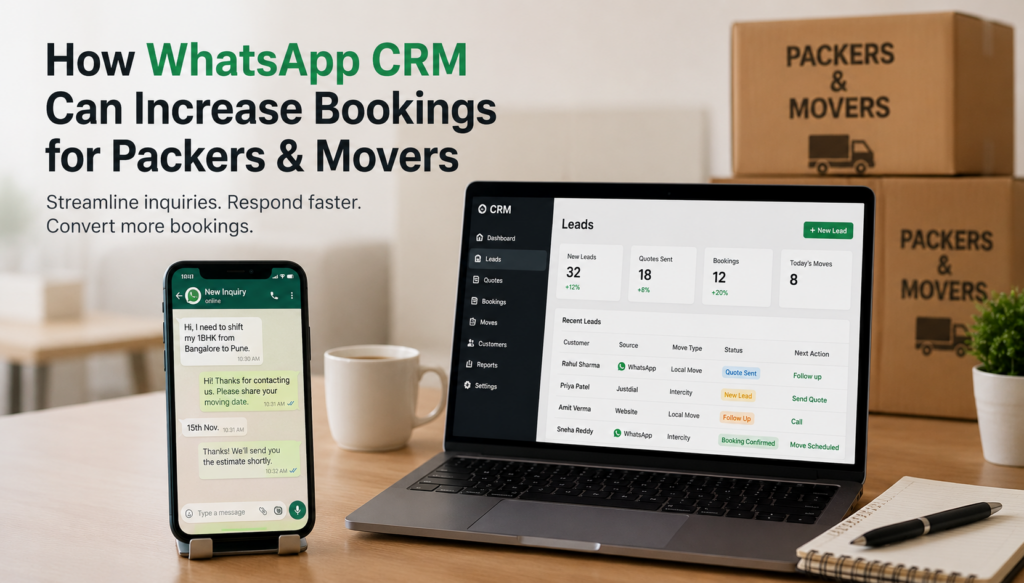
How WhatsApp CRM Can Increase Bookings for Packers & Movers
If you run a packers and movers business in India, WhatsApp is already at the centre of almost everything you do. Inquiries come in on WhatsApp. Quotes get sent on WhatsApp. Customers ask follow-up questions on WhatsApp. Crew updates happen on WhatsApp. Payment details get shared on WhatsApp. The application has essentially become the operational backbone of the Indian moving industry — which makes it both incredibly useful and increasingly difficult to manage as business volume grows. The problem isn’t WhatsApp itself. The problem is using WhatsApp as a standalone tool without any structure around it. A WhatsApp CRM for Packers and Movers that integrates WhatsApp communication within a proper customer management system is what turns the channel your customers already prefer into a systematic, conversion-optimised sales process — rather than an overflowing inbox where leads disappear between conversations. This blog explains exactly how that works and why it matters for growing your booking numbers in 2026. The WhatsApp Problem That Most Moving Companies Have Let’s be direct about what unstructured WhatsApp management actually looks like at scale — because most moving company owners recognise this pattern immediately. A customer sends a moving inquiry at 10 am. You reply, collect the basic details, and tell them you’ll send a quote shortly. Another three inquiries come in while you’re working on the first one. A customer from yesterday follows up asking if you received their message. A crew member is messaging about today’s job. Two potential customers from JustDial and Sulekha are also waiting. By the time you get back to the first inquiry with the quote, it’s 1 pm — three hours after they first reached out — and they’ve already booked with a competitor who responded in twenty minutes. This isn’t a work ethic problem. It’s a systems problem. And it costs Indian moving companies enormous amounts of revenue every single month — not through bad service or uncompetitive pricing, but through response gaps in a channel that customers expect to be fast. CRM for Packers and Movers which supports integration with WhatsApp right out of the box turns all of this around by making your inquiries channel highly structured, fast, and visible. What WhatsApp CRM Actually Does Unified Inbox for All Inquiries The first and most immediate improvement a WhatsApp CRM for Moving Companies delivers is a unified view of every inquiry — regardless of which channel it came from, in a single, organised interface. Instead of scrolling through a chaotic WhatsApp conversation list trying to remember which customers have been quoted, which are waiting for follow-up, and which ones you’re no longer sure about, a CRM presents every lead in a structured pipeline. New inquiry from WhatsApp — visible in the CRM. Lead from JustDial also visible in the CRM. Phone inquiry — logged in the CRM—every source, one place, every lead visible with its current status and next required action. This sounds like a simple organisational improvement. In practice, it is a revenue improvement — because leads that were previously getting lost in the scroll are now visible and tracked, and the system now triggers the follow-up that was previously dependent on individual memory. Quote Generation and Sending Within the Same Platform This is the feature that most directly drives booking conversion for Indian moving companies — and it’s the one that makes the biggest immediate difference when switching from unstructured WhatsApp to a Packers and Movers CRM with proper integration. When a moving inquiry arrives through WhatsApp, the operator can generate a complete, professional moving estimate within the CRM — accounting for distance, approximate volume, move type, packing requirements, vehicle type, and any special items — and send that estimate directly through WhatsApp from the same platform in under two minutes. The customer receives a professional, detailed moving estimate on WhatsApp — the channel they’re already using — without the operator having to switch between applications, manually calculate costs, type out a formatted quote, copy-paste it into WhatsApp, and then try to remember to log the interaction somewhere. The speed improvement here is dramatic. A quote that previously took 30 to 45 minutes from inquiry to delivery — because of the manual calculation, formatting, and channel-switching involved — takes under two minutes with a purpose-built moving company CRM. In a market where response speed is one of the primary conversion factors, this is a direct booking increase. How WhatsApp CRM Specifically Increases Bookings Faster Response = More Bookings The statistics on lead response time in service industries are consistent and clear: the probability of converting a lead drops significantly as response time increases. A customer who receives a professional quote within 15 minutes of sending an inquiry is substantially more likely to book than one who receives the same quote three hours later. Indian moving customers typically send inquiries to two or three companies simultaneously. The company that responds first with a professional, complete estimate captures the booking at a conversion rate far higher than any competitor who responds later — regardless of whether the pricing is identical. WhatsApp lead management within a CRM that enables sub-two-minute quote generation directly through the channel the customer is already using produces first-response advantage on a consistent basis — not occasionally when the operator happens to be at their desk, but systematically, across every inquiry, because the process is fast enough to be executed immediately rather than queued for later. Systematic Follow-Up That Doesn’t Depend on Memory The follow-up failure is one of the most consistent and most expensive patterns in the Indian moving industry. A customer receives a quote, expresses interest, and then goes quiet — perhaps comparing options, perhaps waiting to confirm dates, perhaps just busy for a day or two. The company that follows up on day two with a brief, friendly message converts a meaningful percentage of these leads. The company that forgets about them because the day got busy loses them entirely. In an unstructured WhatsApp environment, follow-up is entirely dependent on
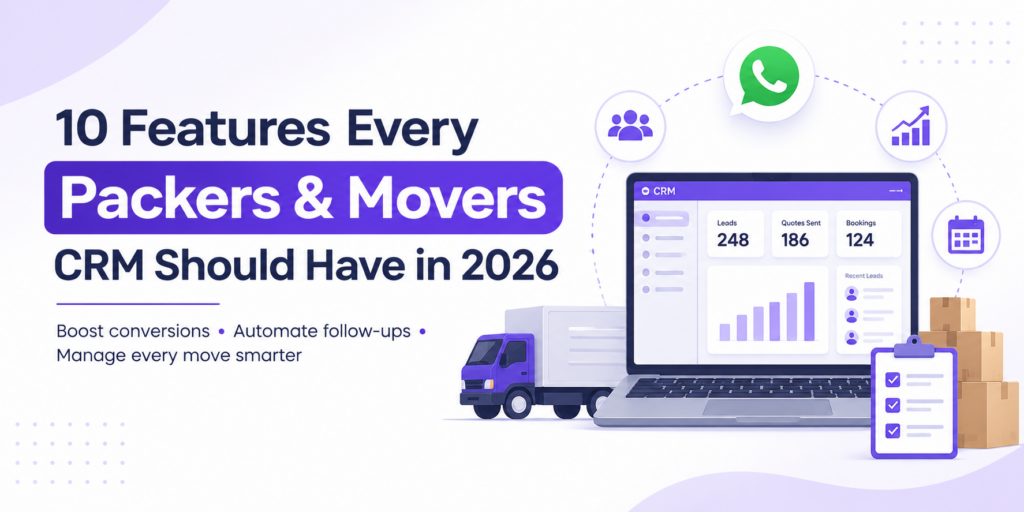
10 Features Every Packers and Movers CRM Should Have in 2026
If you run a packers and movers business in India, you’ve probably experienced the moment where a promising lead just disappeared, not because your rates were too high or your service wasn’t good enough, but simply because someone else got back to them faster. Or maybe you’ve lost track of a follow-up that you genuinely meant to send and only remembered it three days later when it was already too late. These aren’t failures of effort. They’re failures of the system. And in 2026, the gap between moving companies that have the right Packers and Movers CRM and those that don’t is increasingly the gap between businesses that are growing and businesses that are stuck. But not every CRM is built equally, and the generic sales tools that work for software companies or financial services firms don’t address the specific operational reality of a moving business. This blog covers the 10 features that genuinely matter in a CRM for Packers and Movers, the capabilities that translate directly into faster conversions, fewer lost leads, and a more organised operation. Why Feature Selection Matters More Than Brand Recognition Before getting into the features themselves, it’s worth making one important point about how to approach the evaluation. The most widely known CRM platforms, Zoho, HubSpot, and Salesforce, are well-known because they serve enormous, diverse markets. They are built to be flexible and adaptable across industries. This means they can be configured to work for a moving company, but configuration takes time, requires ongoing maintenance, and results in a system that approximates what a moving business needs rather than precisely fitting it. Moving Company CRM software built specifically for the moving industry doesn’t need to be configured. The workflows, the quote variables, the communication channels, and the pipeline stages already match the way a moving business actually operates. The features listed below are what you should expect to find ready-to-use in a genuinely industry-specific platform, not features you’d need to build yourself through customisation of a generic tool. Feature 1: WhatsApp-Native Quote Generation This is the most critical feature in any Packers and Movers Software designed for the Indian market — and the one with the most direct impact on conversion rates. In India, moving inquiries arrive primarily through WhatsApp. Customer communication throughout the sales process happens through WhatsApp. The expectation of the customer who has sent a moving inquiry to two or three companies is that they’ll receive a response through WhatsApp — not through email, not through a web portal, but through the same application where they sent the inquiry. WhatsApp-native quote generation means the CRM allows you to create a complete, professional moving estimate accounting for distance, volume, move type, packing requirements, vehicle type, and special items and send that estimate directly through WhatsApp from within the CRM interface in under two minutes. The difference between this and the current process in most Indian moving companies manual calculation in a spreadsheet or notebook, formatted into a message, copy-pasted into WhatsApp- is the difference between responding in two minutes and responding in forty. In a market where the first professional quote typically wins the booking, two minutes versus forty is a direct revenue difference. Feature 2: Visual Lead Pipeline Management A Packers Movers Management Software without clear pipeline visibility is like running a business from memory- possible, but inefficient and error-prone. The pipeline should show every active lead in a visual, easily scannable format — organised by stage, from new inquiry through quote sent, follow-up due, booking confirmed, and job in progress. At a glance, the owner or manager should be able to answer: how many leads came in this week? How many have been quoted? How many are waiting for a decision? How many need follow-up today? Questions like these, which need to reassemble WhatsApp conversations or review several notes, should be possible to ask and get answers to within seconds from the dashboard. This is not just a time-saving feature but the difference between being in charge of your business and always having to rediscover lost leads. The pipeline should also be customisable to the specific stages your business uses because the sales process of a local Bangalore moving company may have slightly different stages than a company specialising in intercity moves. Feature 3: Automated Follow-Up Reminders Research across service industries consistently shows that a significant percentage of lost leads were not actually disinterested — they didn’t receive a follow-up at the right moment. They got your quote, thought about it, got busy with something else, and when they came back to the decision a few days later, they went with the company that happened to be at the top of their recent messages. Best CRM for Packers and Movers platforms include automated follow-up reminders that ensure this doesn’t happen. When a quote is sent, the CRM schedules a follow-up action at a defined interval — a reminder to the sales team, or an automated follow-up message that the team can review and send in seconds. If the lead still hasn’t responded after a second interval, another action is triggered. The precise mechanism matters less than the consistency. Every lead that needs follow-up gets it, regardless of how many other things are happening in the business that day. The follow-up that falls off the list because the day got busy is one of the most consistent sources of revenue loss in Indian moving companies — and automation addresses it directly. Feature 4: Professional Quote Templates The professionalism of your initial quote is a trust signal that customers evaluate before they’ve had any other interaction with your company. A detailed, clearly formatted estimate that covers all the relevant variables — pickup and delivery addresses, move type, approximate volume or item count, packing materials, vehicle type, labour, floor access considerations, and any special items — signals organisational competence in a way that a rough figure on a WhatsApp message does not. Movers CRM Software should include professionally designed quote templates that