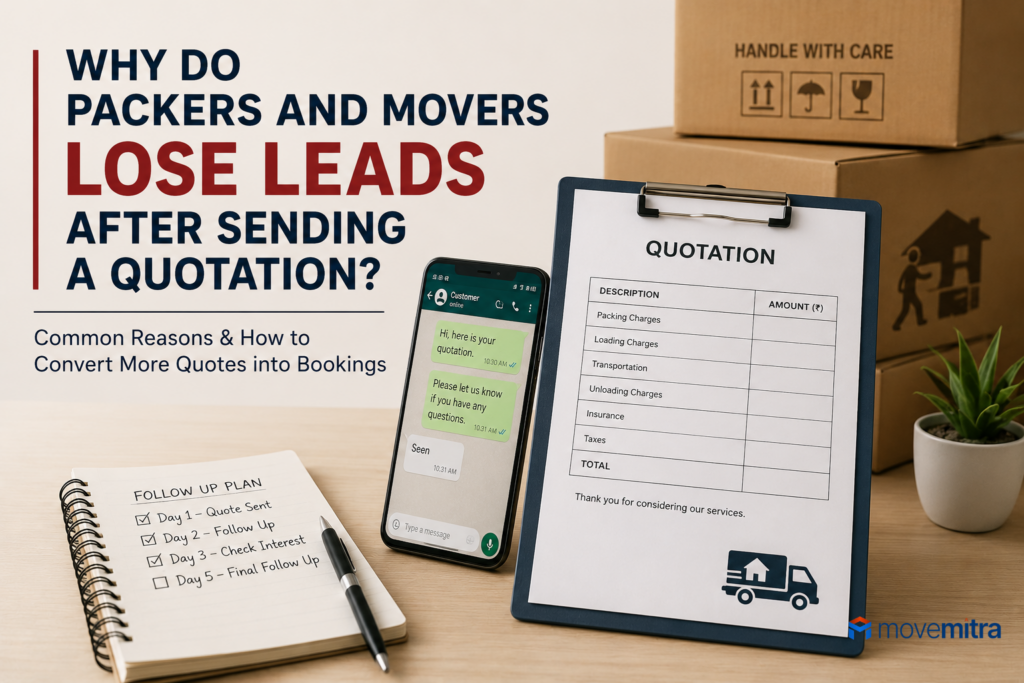
Everything seemed to be going right. Your client contacted you, you asked the appropriate questions, you estimated the cost correctly, and you submitted your packers and movers quote via WhatsApp. Then nothing. Silence. The day goes by, the next one follows, and what seemed like an interested potential client has gone into hiding. If this sounds familiar, and for most Indian moving company owners, it will sound very familiar- you’re experiencing one of the most consistent and most costly patterns in the industry. Packers and movers lose leads after quotation not because their prices are too high or their service isn’t good enough. They lose them for specific, identifiable reasons that have nothing to do with the quality of the move itself and everything to do with what happens — or doesn’t happen after the quote is sent. This blog identifies those reasons precisely and explains what the companies that consistently convert more leads are doing differently. The Quotation Is Not the End of the Sale This is the mindset shift that separates moving companies with high conversion rates from those that send quotes into a void and wonder why they don’t convert. Sending a quotation is not completing the sales process. It is opening a window of time during which the customer is evaluating options, discussing with family, comparing your quote with others they’ve received, and waiting for something to tip their decision in one direction or another. What happens in that window determines whether you get the booking. Most Indian moving companies treat the quotation as the final step — send it, then wait to see what happens. Companies with strong moving company lead conversion treat the quotation as a milestone in an ongoing process that continues until the customer makes a decision. The difference in booking rates between these two approaches is significant. Reason 1: The Quotation Took Too Long to Arrive By the time many Indian moving companies send their quotation, the customer has already half-decided to go with someone else. Here’s the typical scenario: a customer sends moving inquiries to three or four companies simultaneously on a Monday morning. Company A responds with a professional quote within 15 minutes. Company B calls to gather more information and sends a quote two hours later. Company C sends a quote on Tuesday. Company D never gets back to them at all. Company A gets an unfair advantage in this scenario because it is not due to their pricing or the quality of service provided, but simply because of speed. The thought process of the customer is affected by how fast they can get a quick response from a professional. Once other quotes arrive, the customer will feel like they are working against their own decisions. Packers and movers lead management that includes fast quote generation, enabling professional estimates to be sent in under two minutes, eliminating this first-mover disadvantage. Every quote arrives when the decision window is fully open rather than partially closed. Reason 2: The Quotation Was Unprofessional or Incomplete The quotation is not just a price; it’s a representation of how professionally your company operates. A customer who receives a rough figure in an informal WhatsApp message is making a judgment about your business based on that message. A customer who receives a detailed, itemised, professionally formatted estimate is making a very different judgment. A quote that comes off unprofessionally makes the client skeptical precisely at the time they are weighing up the option to give you their belongings. This is because it poses some questions that the client cannot answer; for example, is the price fixed? A professional quotation complete with itemised costs, clear terms, company branding, and contact information answers these questions before they’re asked and builds the confidence that converts an interested prospect into a confirmed booking. Moving company sales management that includes professional quote templates automatically populated from inquiry details ensures that every customer receives the same high-quality, consistent communication — regardless of which team member handles the inquiry or how busy the day is. Reason 3: Nobody Followed Up After the Quote Was Sent This is the most consistent and most costly reason packers and movers lose leads after quotation, and it’s the one most directly within the control of the moving company. If a customer gets a quote and does not respond straight away, this does not mean that they are not interested in the offer. On the contrary, the customer may need some time to compare the offers, or they might be waiting for their relocation date to be confirmed with an employer or landlord. The moving company that follows up on day two with a brief, professional message, acknowledging the quote, offering to answer any questions, and making it easy to take the next step — converts a meaningful percentage of these apparently cold leads. The company that assumes silence means disinterest loses them entirely. In most Indian moving businesses, lead follow-up for packers and movers is entirely dependent on someone remembering to do it — in the middle of a day that already involves managing active jobs, crew schedules, and new incoming inquiries. The follow-up that should happen on day two gets pushed to day four, then forgotten entirely when a new priority appears. This is precisely the pattern that CRM-based follow-up automation addresses. When a quote is sent, the system schedules follow-up actions automatically. The right message reaches the right customer at the right moment — without depending on anyone’s memory. Reason 4: The Customer Couldn’t Reach You When They Were Ready to Book Moving decisions are often made impulsively — at a specific moment when the customer has all the necessary information and feels ready to commit. If your company isn’t immediately reachable at that moment, the conversion goes to whoever is. A customer who decided at 8 pm that they want to book a move, tried to call your number, got no answer, and then saw another company’s WhatsApp message at the
How Packers and Movers Can Reduce Delays With Better Crew Coordination
If you own a packers and movers company in India, then you must be aware of the experience. You have the truck fully loaded, the customer is waiting at his new location, and some way or the other, half of your team is still at the old location due to the simple reason that they were not informed that the loading process was delayed. This is not mere bad luck. This is the consequence of crew management of packers and movers by relying on calls and WhatsApp messages and the power of memory alone. Delays rarely happen because your team is lazy or careless. They happen because information does not travel fast enough between the office, the driver, the loaders, and the customer. By the time someone realizes there is a problem, the truck is already an hour behind schedule. Why Moving Jobs Get Delayed in the First Place Before fixing the problem, it helps to understand where things actually go wrong. Most operational delays in this industry come from a handful of repeat offenders. No clear job briefing. Crews often show up to a site without knowing the full scope of the job, whether there is a lift available, how many floors they are dealing with, or whether the customer has any special items like a piano or an aquarium. This leads to on-site confusion and lost time. Overlapping schedules. When job assignments are managed on a whiteboard or a group chat, it is easy to double-book a crew or a vehicle without anyone noticing until the morning of the move. Poor visibility for the office team. The person coordinating from the back office often has no real way to know where a crew is at any given moment. They are relying on someone picking up a phone call, and calls get missed during a heavy loading job. Last-minute crew changes. Someone falls sick, a vehicle breaks down, or a job runs longer than planned, and now the next job in line is short-staffed with no backup plan ready. Each of these on its own seems small. Together, they are exactly why packers and movers operational delays keep piling up week after week, quietly eating into both revenue and reputation. What Good Crew Coordination Actually Looks Like A well-run moving company does not avoid delays because it never runs into problems. It avoids delays because problems get spotted and solved before the customer even notices. That difference comes down to how well the crew, the office, and the vehicles are connected. Coordination requires that each individual knows their responsibilities in advance and not while proceeding to the work location. It requires that the office knows where each crew is at any point in time, whether free, working, or late. This also requires that whenever there is a change in plans, all those affected will be informed immediately. This is where crew management for moving companies stops being a nice-to-have and becomes something that directly protects your bottom line. When you can see your entire day’s operations at once instead of piecing it together from five different phone calls, you start catching problems while they are still small. Real-Time Tracking Changes the Game One of the biggest shifts happening in the Indian moving industry right now is the move toward real-time crew tracking that moving business owners can actually rely on. Instead of calling a supervisor to ask, “Where is the team right now,” the answer is visible on a screen. It is more important than one would think. Instead of making a guess as to when the truck will be there, your people have a definitive response they can provide that is both true and reliable. If the job has been delayed in any way, the office will know right away and can either schedule accordingly or send reinforcements. There is little that can build a customer’s confidence more than transparency. Scheduling Is Half the Battle The vast majority of the delays originate from lack of proper planning and not bad execution. Scheduling the correct crew for packers and movers implies using the appropriate amount of staff, their skill set, and the appropriate vehicle for the task without any overlap or understaffing. It is possible to use spreadsheets, or even paper registers, for manual scheduling when the daily load does not exceed two or three jobs. However, when the operations scale increases, manual scheduling fails, particularly at the height of the relocation period when all the crews get overloaded. With properly managed crew scheduling, it is ensured that no one is overloaded and that there are realistic allowances for traffic and loading times. Why Technology Is Becoming Non-Negotiable More moving companies across India are now turning to crew management software to bring order to their daily operations. This is not about replacing your team’s hard work; it is about giving them the information they need at the right moment. An effective system allows you to assign the work digitally, monitor the process as the crews complete each job, and be alerted at the first sign of any delays. Combine that with mobile job tracking software, and you will have real-time data on all trucks, crews, and jobs without making even one phone call. It is precisely this kind of disconnect that a good packers and movers CRM solution in India addresses. Rather than having one book for handling customer inquiries, another for handling task assignments, and yet another for billing, everything comes together in one place. The sales team is aware of the commitment made to the customer, while the operations team has an understanding of what is to be delivered, and the crew is aware of the exact location at which it is to operate. Such an interconnected approach, similar to that adopted by companies like MoveMitra through its dedicated crew management solutions, streamlines the process immensely. Practical Steps You Can Take This Week You do not need to overhaul your entire business overnight to see improvement.
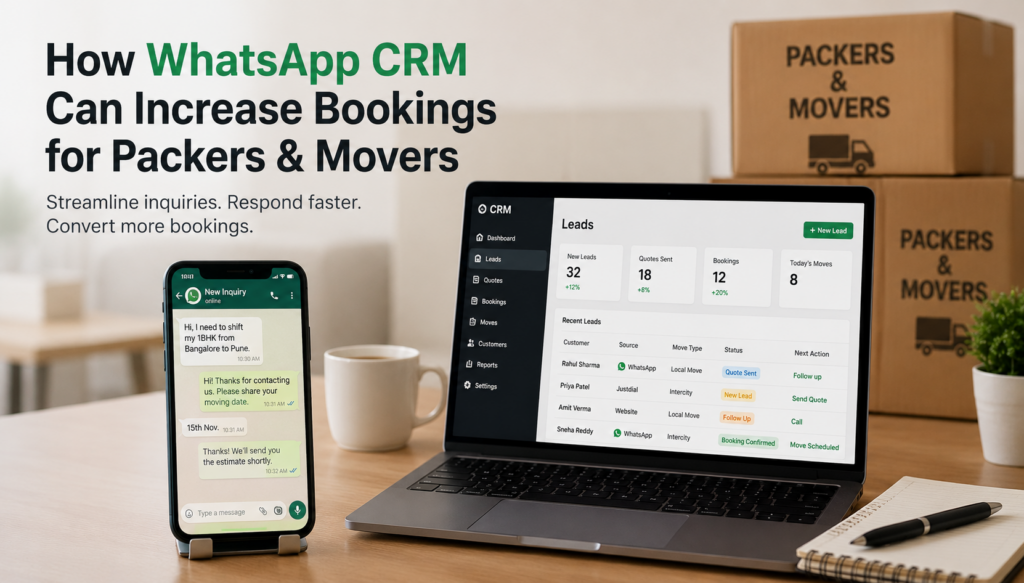
How WhatsApp CRM Can Increase Bookings for Packers & Movers
If you run a packers and movers business in India, WhatsApp is already at the centre of almost everything you do. Inquiries come in on WhatsApp. Quotes get sent on WhatsApp. Customers ask follow-up questions on WhatsApp. Crew updates happen on WhatsApp. Payment details get shared on WhatsApp. The application has essentially become the operational backbone of the Indian moving industry — which makes it both incredibly useful and increasingly difficult to manage as business volume grows. The problem isn’t WhatsApp itself. The problem is using WhatsApp as a standalone tool without any structure around it. A WhatsApp CRM for Packers and Movers that integrates WhatsApp communication within a proper customer management system is what turns the channel your customers already prefer into a systematic, conversion-optimised sales process — rather than an overflowing inbox where leads disappear between conversations. This blog explains exactly how that works and why it matters for growing your booking numbers in 2026. The WhatsApp Problem That Most Moving Companies Have Let’s be direct about what unstructured WhatsApp management actually looks like at scale — because most moving company owners recognise this pattern immediately. A customer sends a moving inquiry at 10 am. You reply, collect the basic details, and tell them you’ll send a quote shortly. Another three inquiries come in while you’re working on the first one. A customer from yesterday follows up asking if you received their message. A crew member is messaging about today’s job. Two potential customers from JustDial and Sulekha are also waiting. By the time you get back to the first inquiry with the quote, it’s 1 pm — three hours after they first reached out — and they’ve already booked with a competitor who responded in twenty minutes. This isn’t a work ethic problem. It’s a systems problem. And it costs Indian moving companies enormous amounts of revenue every single month — not through bad service or uncompetitive pricing, but through response gaps in a channel that customers expect to be fast. CRM for Packers and Movers which supports integration with WhatsApp right out of the box turns all of this around by making your inquiries channel highly structured, fast, and visible. What WhatsApp CRM Actually Does Unified Inbox for All Inquiries The first and most immediate improvement a WhatsApp CRM for Moving Companies delivers is a unified view of every inquiry — regardless of which channel it came from, in a single, organised interface. Instead of scrolling through a chaotic WhatsApp conversation list trying to remember which customers have been quoted, which are waiting for follow-up, and which ones you’re no longer sure about, a CRM presents every lead in a structured pipeline. New inquiry from WhatsApp — visible in the CRM. Lead from JustDial also visible in the CRM. Phone inquiry — logged in the CRM—every source, one place, every lead visible with its current status and next required action. This sounds like a simple organisational improvement. In practice, it is a revenue improvement — because leads that were previously getting lost in the scroll are now visible and tracked, and the system now triggers the follow-up that was previously dependent on individual memory. Quote Generation and Sending Within the Same Platform This is the feature that most directly drives booking conversion for Indian moving companies — and it’s the one that makes the biggest immediate difference when switching from unstructured WhatsApp to a Packers and Movers CRM with proper integration. When a moving inquiry arrives through WhatsApp, the operator can generate a complete, professional moving estimate within the CRM — accounting for distance, approximate volume, move type, packing requirements, vehicle type, and any special items — and send that estimate directly through WhatsApp from the same platform in under two minutes. The customer receives a professional, detailed moving estimate on WhatsApp — the channel they’re already using — without the operator having to switch between applications, manually calculate costs, type out a formatted quote, copy-paste it into WhatsApp, and then try to remember to log the interaction somewhere. The speed improvement here is dramatic. A quote that previously took 30 to 45 minutes from inquiry to delivery — because of the manual calculation, formatting, and channel-switching involved — takes under two minutes with a purpose-built moving company CRM. In a market where response speed is one of the primary conversion factors, this is a direct booking increase. How WhatsApp CRM Specifically Increases Bookings Faster Response = More Bookings The statistics on lead response time in service industries are consistent and clear: the probability of converting a lead drops significantly as response time increases. A customer who receives a professional quote within 15 minutes of sending an inquiry is substantially more likely to book than one who receives the same quote three hours later. Indian moving customers typically send inquiries to two or three companies simultaneously. The company that responds first with a professional, complete estimate captures the booking at a conversion rate far higher than any competitor who responds later — regardless of whether the pricing is identical. WhatsApp lead management within a CRM that enables sub-two-minute quote generation directly through the channel the customer is already using produces first-response advantage on a consistent basis — not occasionally when the operator happens to be at their desk, but systematically, across every inquiry, because the process is fast enough to be executed immediately rather than queued for later. Systematic Follow-Up That Doesn’t Depend on Memory The follow-up failure is one of the most consistent and most expensive patterns in the Indian moving industry. A customer receives a quote, expresses interest, and then goes quiet — perhaps comparing options, perhaps waiting to confirm dates, perhaps just busy for a day or two. The company that follows up on day two with a brief, friendly message converts a meaningful percentage of these leads. The company that forgets about them because the day got busy loses them entirely. In an unstructured WhatsApp environment, follow-up is entirely dependent on
Top 10 Challenges Packers and Movers Face (And How CRM Solves Them)
Running a packers and movers business in India is genuinely rewarding and genuinely exhausting. The inquiries come in from multiple channels simultaneously. The quotes pile up. The follow-ups get missed. The crew scheduling becomes a daily puzzle. The billing gets delayed. And somewhere in the middle of managing all of this, a customer who had a great experience never gets asked to leave a review, while one who had a complaint leaves one anyway. These aren’t unusual situations. They are the Packers and Movers Challenges that show up in virtually every moving company in India, from single-vehicle operators to multi-city fleets. And what’s worth understanding clearly in 2026 is that most of these challenges aren’t caused by lack of effort or poor service quality. They’re caused by the absence of the right systems — specifically, the absence of a packers and movers CRM built for the way Indian moving companies actually operate. This blog names the ten most significant challenges and explains specifically how the right software solves each one. Challenge 1: Inquiries Coming From Too Many Places at Once In a regular Indian packers and movers company, customer queries pour in through WhatsApp, calls, web forms, Sulekha, UrbanClap, JustDial, and referral services at once, all of which need immediate attention. It becomes impossible to deal with all these queries from different sources without having a common platform. Some customers will definitely slip through the cracks. If an inquiry comes through WhatsApp, another inquiry is received by phone, and there is an inquiry from JustDial, and all of this occurs when the owner is overseeing a moving operation, then the chance of missing out on at least one of the inquiries is extremely high. Custom-made CRM software for the packers & movers industry in India combines all these different channels of inquiry within one platform. Leads from all sources show up in the same pipeline, traceable, assigned, and managed through one process. No leads get lost in WhatsApp chats or in a missed call list. Challenge 2: Quotes That Take Too Long to Generate This is probably the most expensive single challenge in the Indian moving industry, and it’s the one most directly solved by the right packers and movers software. A customer who sends a moving inquiry in 2026 is typically asking three or four companies simultaneously. The first company to send a professional, complete quote has an enormous conversion advantage. The company that calls back two hours later to gather information before calculating a quote manually and sending it the following morning has already lost the booking in most cases. The manual quotation process, calculating volume, distance, packing requirements, vehicle type, floor access, labour cost, and special items takes time even for experienced operators. And then formatting it into something professional enough to send directly to the customer takes more time still. A CRM solution that produces a fully formatted moving estimate within two minutes and delivers it through WhatsApp from the system itself helps avoid this roadblock. This time-saving feature is one of the quickest revenue boosters a moving business can implement. Challenge 3: No Systematic Follow-Up Process Ask any honest moving business owner how many potential clients they have missed out on because no follow-up was done after the first quote, and the answer will make one very uncomfortable- not because of a lack of effort by the team, but because the system of follow-up rested solely on memory. A customer who gets a quote and doesn’t reply right away is usually still interested; they may be comparing different options, talking it over with their family, or waiting for a salary increase. A business that sends a short and professional message to such a customer two or three days after the quote is received succeeds in converting a significant proportion of these uncertain prospects. On the other hand, a company that believes silence means a lack of interest misses out on a large amount of revenue each month. Lead management for packers and movers in a good CRM automates this entirely. When a quote is sent, a follow-up reminder is scheduled automatically. If there’s no response, another action is triggered. The follow-up happens consistently regardless of how busy the day is because the system manages it, not the team’s memory. Challenge 4: Crew Scheduling That Becomes a Daily Puzzle On any given day, a moving company might have three jobs — each requiring different crew sizes, different vehicles, and different start times — alongside a fourth job that was just confirmed and needs to be slotted in without affecting the others. Managing this in a notebook, a whiteboard, or a shared WhatsApp group produces confusion that affects both the team and the customer experience. Crew members appearing in the wrong place, double-booking vehicles. A customer who was informed of his crew being available from 9 in the morning is called at 8:45 am, informing him of their delayed arrival, as their schedule was changed on a WhatsApp broadcast which some people missed. Packers and movers management software with job scheduling and crew assignment replaces the whiteboard and WhatsApp group with a connected scheduling interface. Each job has an assigned crew, an assigned vehicle, confirmed timing, and automatic notifications sent to the relevant team members. Everyone has the same information at the same time, from their own device. Challenge 5: No Visibility Into the Business Pipeline It’s a problem that most moving company executives are not explicit about, but one that they face every day: the inability to provide, at a particular point in time, the number of leads currently in the pipeline, the number of those who have received quotes, the number of bookings for the coming week, and the projected monthly revenue. In an enterprise where WhatsApp messaging and scribbling notes form the medium of conducting business, the process of answering such questions will require piecing together the whole conversation in one’s mind. It is not merely frustrating but impossible. Customer management software with