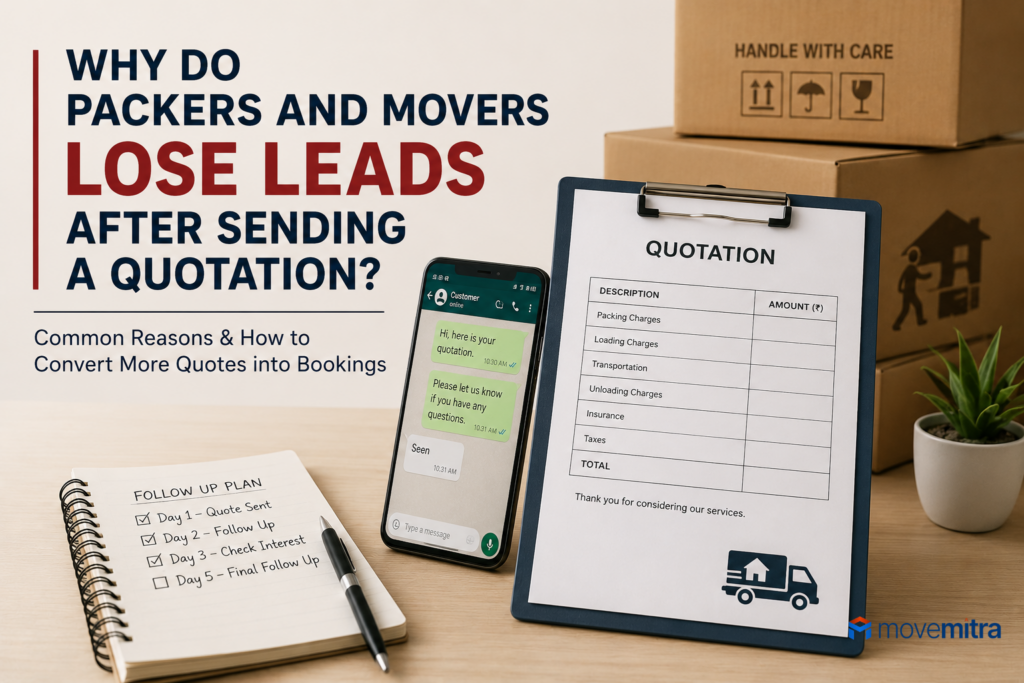
Everything seemed to be going right. Your client contacted you, you asked the appropriate questions, you estimated the cost correctly, and you submitted your packers and movers quote via WhatsApp. Then nothing. Silence. The day goes by, the next one follows, and what seemed like an interested potential client has gone into hiding. If this sounds familiar, and for most Indian moving company owners, it will sound very familiar- you’re experiencing one of the most consistent and most costly patterns in the industry. Packers and movers lose leads after quotation not because their prices are too high or their service isn’t good enough. They lose them for specific, identifiable reasons that have nothing to do with the quality of the move itself and everything to do with what happens — or doesn’t happen after the quote is sent. This blog identifies those reasons precisely and explains what the companies that consistently convert more leads are doing differently. The Quotation Is Not the End of the Sale This is the mindset shift that separates moving companies with high conversion rates from those that send quotes into a void and wonder why they don’t convert. Sending a quotation is not completing the sales process. It is opening a window of time during which the customer is evaluating options, discussing with family, comparing your quote with others they’ve received, and waiting for something to tip their decision in one direction or another. What happens in that window determines whether you get the booking. Most Indian moving companies treat the quotation as the final step — send it, then wait to see what happens. Companies with strong moving company lead conversion treat the quotation as a milestone in an ongoing process that continues until the customer makes a decision. The difference in booking rates between these two approaches is significant. Reason 1: The Quotation Took Too Long to Arrive By the time many Indian moving companies send their quotation, the customer has already half-decided to go with someone else. Here’s the typical scenario: a customer sends moving inquiries to three or four companies simultaneously on a Monday morning. Company A responds with a professional quote within 15 minutes. Company B calls to gather more information and sends a quote two hours later. Company C sends a quote on Tuesday. Company D never gets back to them at all. Company A gets an unfair advantage in this scenario because it is not due to their pricing or the quality of service provided, but simply because of speed. The thought process of the customer is affected by how fast they can get a quick response from a professional. Once other quotes arrive, the customer will feel like they are working against their own decisions. Packers and movers lead management that includes fast quote generation, enabling professional estimates to be sent in under two minutes, eliminating this first-mover disadvantage. Every quote arrives when the decision window is fully open rather than partially closed. Reason 2: The Quotation Was Unprofessional or Incomplete The quotation is not just a price; it’s a representation of how professionally your company operates. A customer who receives a rough figure in an informal WhatsApp message is making a judgment about your business based on that message. A customer who receives a detailed, itemised, professionally formatted estimate is making a very different judgment. A quote that comes off unprofessionally makes the client skeptical precisely at the time they are weighing up the option to give you their belongings. This is because it poses some questions that the client cannot answer; for example, is the price fixed? A professional quotation complete with itemised costs, clear terms, company branding, and contact information answers these questions before they’re asked and builds the confidence that converts an interested prospect into a confirmed booking. Moving company sales management that includes professional quote templates automatically populated from inquiry details ensures that every customer receives the same high-quality, consistent communication — regardless of which team member handles the inquiry or how busy the day is. Reason 3: Nobody Followed Up After the Quote Was Sent This is the most consistent and most costly reason packers and movers lose leads after quotation, and it’s the one most directly within the control of the moving company. If a customer gets a quote and does not respond straight away, this does not mean that they are not interested in the offer. On the contrary, the customer may need some time to compare the offers, or they might be waiting for their relocation date to be confirmed with an employer or landlord. The moving company that follows up on day two with a brief, professional message, acknowledging the quote, offering to answer any questions, and making it easy to take the next step — converts a meaningful percentage of these apparently cold leads. The company that assumes silence means disinterest loses them entirely. In most Indian moving businesses, lead follow-up for packers and movers is entirely dependent on someone remembering to do it — in the middle of a day that already involves managing active jobs, crew schedules, and new incoming inquiries. The follow-up that should happen on day two gets pushed to day four, then forgotten entirely when a new priority appears. This is precisely the pattern that CRM-based follow-up automation addresses. When a quote is sent, the system schedules follow-up actions automatically. The right message reaches the right customer at the right moment — without depending on anyone’s memory. Reason 4: The Customer Couldn’t Reach You When They Were Ready to Book Moving decisions are often made impulsively — at a specific moment when the customer has all the necessary information and feels ready to commit. If your company isn’t immediately reachable at that moment, the conversion goes to whoever is. A customer who decided at 8 pm that they want to book a move, tried to call your number, got no answer, and then saw another company’s WhatsApp message at the